How to control food costs in a restaurant: 12 practices from supplier to plate (2026)
By Asaad Al Hashmi, Founder and CEO of Wady

Food cost control means keeping what you spend on food in the kitchen close to what your recipes say it should cost. You do it by controlling seven points: buying, receiving, storage, prep and portions, transfers to branches, menu prices and waste. This guide covers all seven with 12 practices, worked numbers and a routine.
We are Wady. We make Wady Central, the inventory, recipe and purchasing system for kitchens in Qatar, so the last part of this guide shows how it does this work.
Food cost ranges below come from public industry guides, linked where we use them. Checked on 25 October 2026.
Key takeaways
Food cost leaks at seven points between the supplier and the plate, and each point has one practice that closes it.
Industry guides put a healthy food cost at about 25% to 35% of food sales, and your costed recipes set the target for each dish and branch.
A QAR 4 a kilo beef price rise adds QAR 0.60 to a burger, or QAR 720 a month at 1,200 burgers (example numbers).
With a central kitchen, count a transfer to a branch once, and compare each branch's expected usage with its actual usage.
Close every month by comparing actual with theoretical food cost.
What does food cost control mean?
In practice it comes down to one comparison. The recipe gives the theoretical cost of a dish, and your counts and purchases give the actual cost. The work is closing the distance between the two.
Two terms come up:
Food cost: the cost of the food you sold, shown as a percentage of food sales.
COGS (cost of goods sold): opening stock plus purchases minus closing stock, the same sum in riyals.
For the formula step by step, read how to calculate food cost and recipe cost.
What food cost percentage should a restaurant aim for?
US industry guides put a healthy food cost at about 25% to 35% of food sales: WebstaurantStore says 25% to 35%, and Eat App says 28% to 35%. No published GCC benchmark exists.
Set your own target per dish and per branch from your own costed recipes. Cafes, bakeries and buffets sit in different places, and your menu mix decides your number.
Where does food cost leak?
Food cost leaks at seven points: buying, receiving, storage, prep and cooking, transfers to branches, menu pricing and waste.

Food cost leaks at seven points between the supplier and the bin, and each one has a practice in this guide that closes it.
Qatar's National Food Security Strategy targets cutting food waste by 50% and food loss by 30%. UNEP's Food Waste Index 2024 says food service makes 28% of the food wasted worldwide.
What are the 12 practices that control food cost?
Twelve practices cover the seven leak points. Each one has a reason, a method and a weekly check.
Stage 1: Buy and receive (practices 1 to 4)
1. Cost every recipe on usable yield
Cost each recipe on what is usable after trim, with sub-recipes and packaging in the sum.
Why it matters: a recipe costed on purchase weight understates the plate cost.
How to do it: weigh before and after trim, divide the price by the usable weight, and add sauces and packaging. See recipe yield and trim loss and recipe costing software.
Check: every active dish has a cost per portion under 3 months old.
2. Watch supplier prices on every delivery and re-cost the same day
A supplier price moves your plate cost the day it changes, so compare each invoice line with the last price you paid.

An example made up for this article: a QAR 4 a kilo beef rise moves one burger from 29.5% to 31.1% food cost, about QAR 720 a month.
In the example burger, beef rises from QAR 32 to QAR 36 a kilo, so a 150 g patty goes from QAR 4.80 to QAR 5.40. Plate cost goes from QAR 11.20 to QAR 11.80 at an unchanged QAR 38 menu price, and food cost from 29.5% to 31.1%. At 1,200 burgers, that is QAR 720 a month.
Why it matters: small price moves add up across dozens of ingredients.
How to do it: write the price on every delivery and re-cost the affected recipes that day. Then choose: price, portion or supplier. See what to do when a supplier raises a price.
Check: this week's price changes and the recipes each one touched.
3. Order from real demand and par levels
Order what your sales and production plan need, against a par level for each item: the quantity to hold after a delivery.
Why it matters: over-ordering turns cash into waste, and under-ordering means rush buys at a higher price.
How to do it: set a par for each item, count before you order, and order the gap. See automated purchase orders.
Check: items ordered and binned this week.
4. Receive against the order
Count, weigh and check the price before you sign.
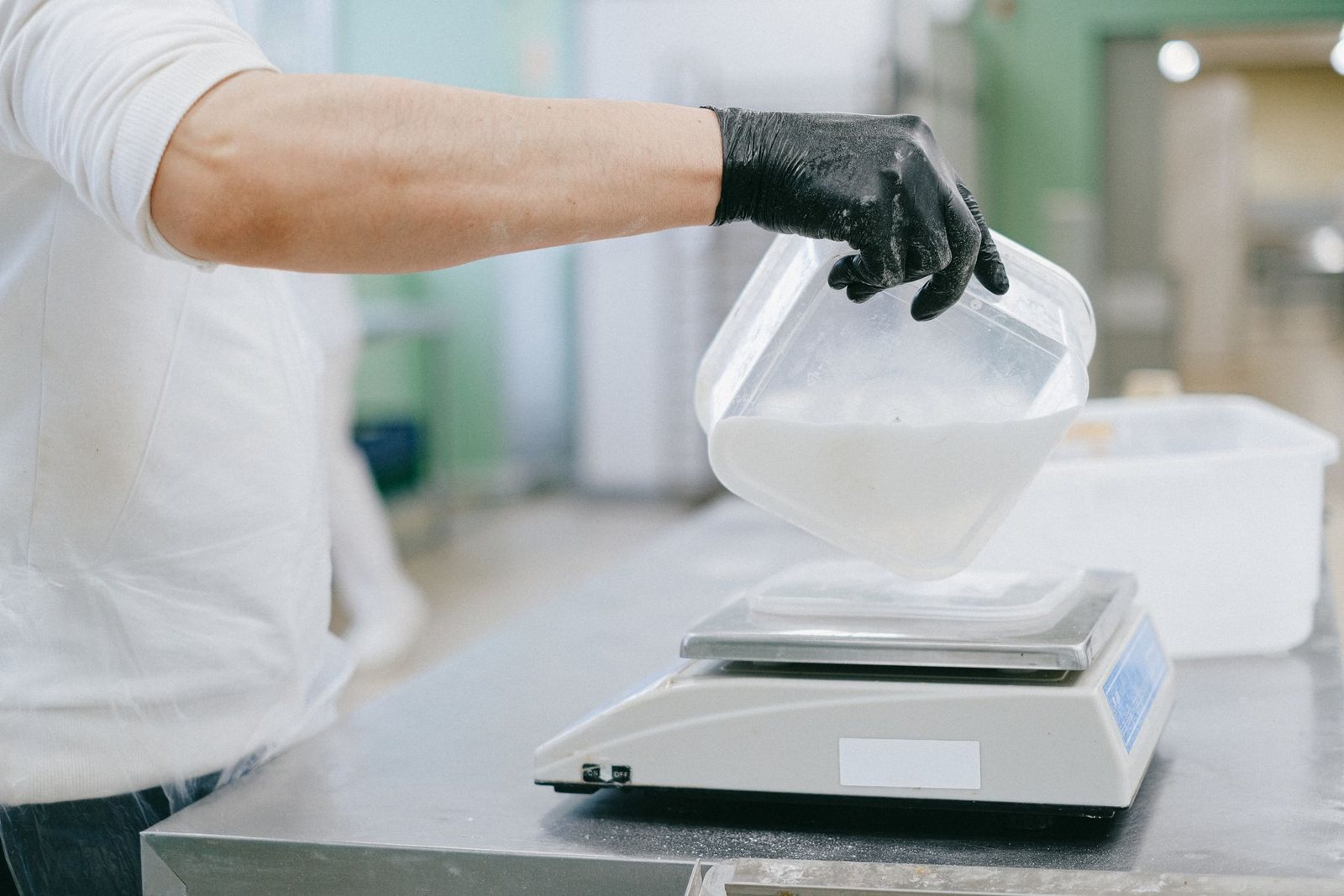
Weighing what arrives, before the driver leaves, is the last moment a short delivery is the supplier's loss.
Why it matters: receiving is the last point where the supplier carries a loss.
How to do it: hold the order beside the delivery, weigh by-weight items, check dates, and note shortages before the driver leaves. See goods receiving procedure.
Check: deliveries with a short, wrong or late line, by supplier.
Stage 2: Store and count (practices 5 and 6)
5. Store first in, first out, and label dates
Put new stock behind old stock and date every container, so the oldest item gets used first.
Why it matters: stock that expires is food cost with no sale behind it.
How to do it: label opened and prepped items.
Check: list items within 2 days of expiry once a week.
6. Count on a schedule
Count your most costly items every week and everything once a month.
Why it matters: the count is the closing stock in your month-end sum.
How to do it: count in the units you buy. Blank means not counted, 0 means none. See restaurant stock count and stock count variance.
Check: items with no count in 6 weeks.
Stage 3: Prep, cook and send (practices 7 to 10)
7. Standard recipes and weighed portions
Write one standard recipe per dish and weigh the portion.

A scale at the station turns the recipe portion into a number the cook can hit on every plate.
Why it matters: an extra 20 g on every plate never shows on an invoice.
How to do it: put a scale at the station, post the recipe card, and give the team a number they own, such as portion weight.
Check: weigh 5 portions of your top 3 dishes each week.
8. Record every waste with a reason, by shift
Write down what goes in the bin, how much and why: spoiled, over-prepped, dropped or returned.
Why it matters: a bin with no record is a cost you cannot trace to a cause.
How to do it: keep the form at the pass, use one short list of reasons, and give the team a number they own, such as waste this week. See how to track food waste.
Check: waste by reason and by item, each week.
9. Plan production from orders, minus stock
In a central kitchen, plan each day's production from the orders received minus the stock you hold.
Why it matters: over-production is waste before it is sent.
How to do it: put every outlet order on one sheet, subtract stock, round to real batches, and buy only what remains. See the daily production plan.
Check: planned quantity against what the cook used, per batch.
10. Confirm every transfer from the kitchen to a branch
Every run that leaves the kitchen needs a delivery note, and the branch confirms what arrived.
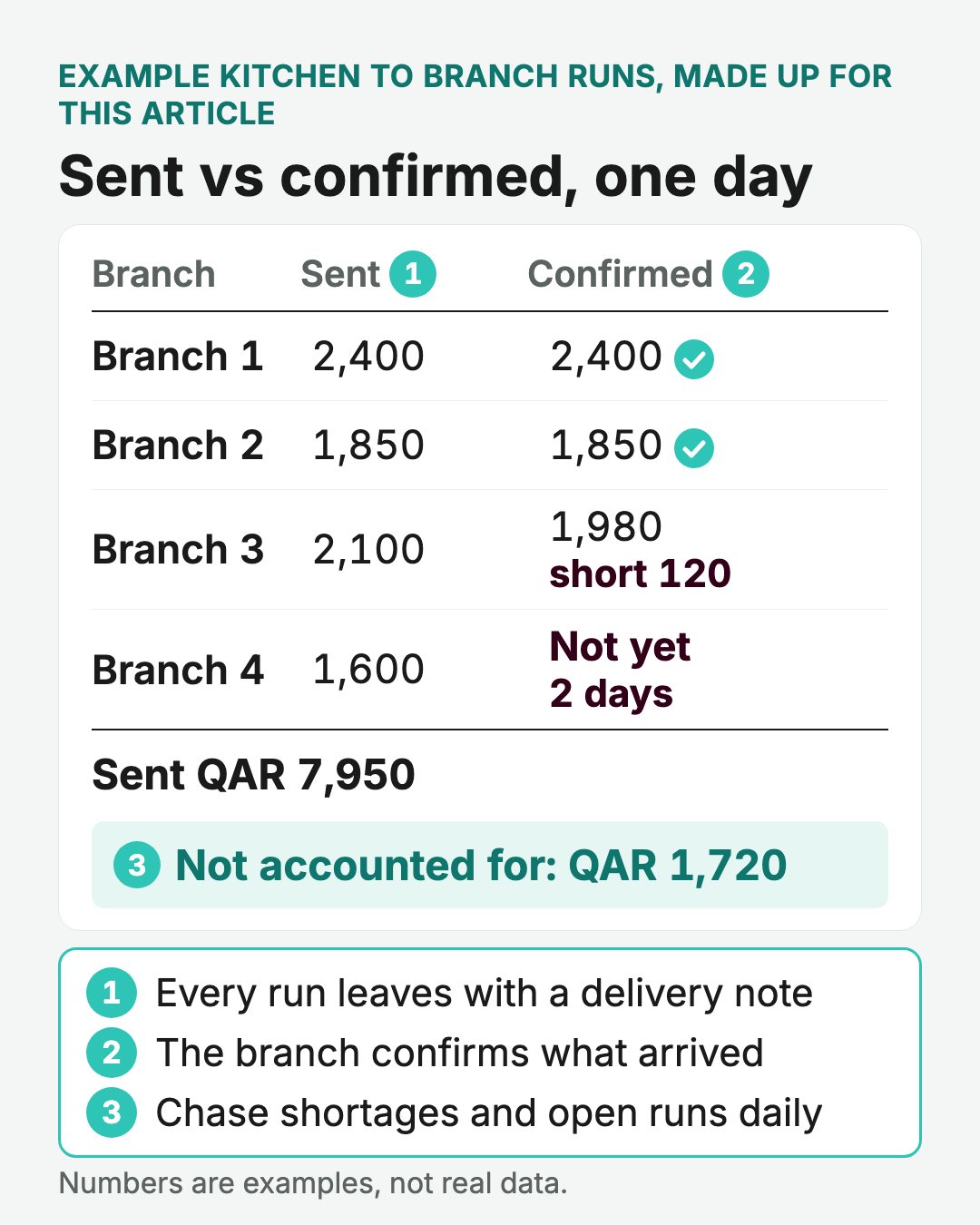
An example made up for this article: of QAR 7,950 sent to four branches in one day, QAR 1,720 is short or still unconfirmed.
In the example day, the kitchen sent QAR 7,950 to four branches. Branch 3 confirmed QAR 1,980 of QAR 2,100, and Branch 4's QAR 1,600 has been in transit for 2 days. That leaves QAR 1,720 not accounted for.
Why it matters: an unconfirmed transfer gets harder to trace each day it stays open.
How to do it: print a signable note for each run, have the branch confirm on arrival, and chase open runs daily. See delivery notes for outlets.
Check: open runs older than 1 day, with their value.
Stage 4: Price and close (practices 11 and 12)
11. Price and engineer the menu from current cost
Work out the margin of every dish from today's cost, then fix the dishes over target.
Why it matters: a menu priced on last year's costs sells dishes at a loss.
How to do it: list each dish with cost, price and food cost %. For each one over target, change the price, portion, supplier or dish. See menu pricing from food cost.
Check: dishes over target this month, and what you did about each.
12. Close the month: actual against theoretical food cost
Compare what your shelves lost (actual) with what your recipes say they should have lost (theoretical).

An example made up for this article: actual food cost of 32.0% against a theoretical 29.0% leaves a QAR 11,300 gap to explain.
In the example, opening stock QAR 42,000 plus purchases QAR 118,000 minus closing stock QAR 38,500 gives an actual food cost of QAR 121,500, or 32.0% of QAR 380,000 in sales. Recipes multiplied by items sold give QAR 110,200, or 29.0%. The gap is QAR 11,300, or 3.0 points.
Why it matters: the gap holds waste, over-portioning, theft and typos.
How to do it: count closing stock, run the sum, compute theoretical from sales and recipes, then chase the biggest item gaps. See theoretical vs actual food cost and month-end COGS reconciliation.
Check: the gap in riyals and in points, against last month.
How do you control food cost across a central kitchen and branches?
A central kitchen and its branches need three extra rules: count transfers once, compare each branch with its own expected usage, and see every open run. Most food cost guides skip these.
Transfers are internal movements, not purchases. Count food when it arrives from the supplier, and a transfer to a branch as a movement. If the branch also counts it as a purchase, its food cost is counted twice.
Compare each branch with itself. Expected usage is items sold multiplied by the recipe. Put expected and actual side by side per branch, because a group total hides the high branch.
One sheet of all outlet orders before production. The kitchen plans from the whole demand.
In-transit stock with value and age. A run on the road for 2 days is an open question.
Shortages recorded with value. A shortage with no riyal figure never gets chased.
Read what is a central kitchen, and if several brands share one kitchen, multiple brands, one central kitchen. Wady Central runs this whole loop, from outlet orders to confirmed delivery, in one system, as the last part of this guide shows.
What is a good daily, weekly and monthly food cost routine?
The routine has three daily, three weekly and three monthly checks, each tied to a practice above.

The food cost routine: three checks every day, three every week and three every month.
Write down waste, with a reason (practice 8).
Check each delivery against the order (practices 2 and 4).
Chase open kitchen runs to branches (practice 10).
Every week
Count your 20 most costly items (practice 6).
Check price changes on deliveries (practice 2).
Read the waste totals by reason (practice 8).
Every month
Run a full stock count (practice 6).
Compare actual with theoretical food cost (practice 12).
Fix the dishes over target (practice 11).
Spreadsheet or software: when does a spreadsheet stop working?
A spreadsheet works for one small kitchen with a steady menu and one person typing. Four signals say it has stopped working.
More than one site. Two files that must agree drift apart.
Prices that move weekly. Every price change means editing every recipe by hand.
More than one person typing. One wrong digit, such as 336 typed as 0.336, runs for a month.
A month-end that takes days. Closing the month takes longer than counting.
Read spreadsheet or software for restaurant inventory.
How Wady Central controls food cost
Wady Central is the inventory, recipe and purchasing system built in Qatar for kitchens of any size, from one cafe to a group with a central kitchen and branches. Every riyal in your kitchen, explained.
Most kitchens find a leak at month-end, weeks after the money left. Wady Central puts all seven leak points from this guide in one system and records each one when it happens: the price on the delivery, the waste on the shift, the run to the branch. Nothing gets typed twice, so every number traces back to the document behind it. Over 100 businesses in Qatar already use Wady, including Crave Holdings and OMC.
What it does
Recipes (practices 1, 11): costed on usable yield after trim, with sub-recipes, packaging and food cost %. Your costing sheet imports as it is, and recipes are re-costed the moment a price moves. See recipes and costing.
Buying and receiving (practices 2, 3, 4): price rises and falls are flagged on delivery, and you receive by confirming, not typing. Suppliers can be on Wady or not: a purchase order goes by email to those who are not. The purchase list is built from the production plan.
Production (practice 9): all outlet orders sit on one sheet, showing only what is still needed. Production is planned from real orders minus stock. You record a run, ingredients out and product in, and what the cook used beats what the recipe said.
Delivery to branches (practice 10): delivery runs come with picking lists and a signable delivery note. Outlets confirm arrival in the same app. The in-transit list shows value and age, and shortages and returns are recorded with value.
Stock history: every balance opens to its full history, with each movement's reason and document. Negative balances are flagged, never hidden, and low-stock alerts show the cost to refill.
Counts and waste (practices 6, 8): count on paper or on screen, in sacks and grams, and review differences with likely typos first. A shift's waste goes in one entry with your reasons, and waste cost shows by period, reason and item.
Control (practice 12): odd numbers are questioned as they are typed. The Daily Brief arrives each morning, costed in riyals, naming which recipes moved cost and which ingredient caused it. Month-end balances per item, and you can export all your data any day, free.
Where it runs: in any browser on a laptop or tablet, with every brand, branch and kitchen in one account, alongside your POS and accounting.
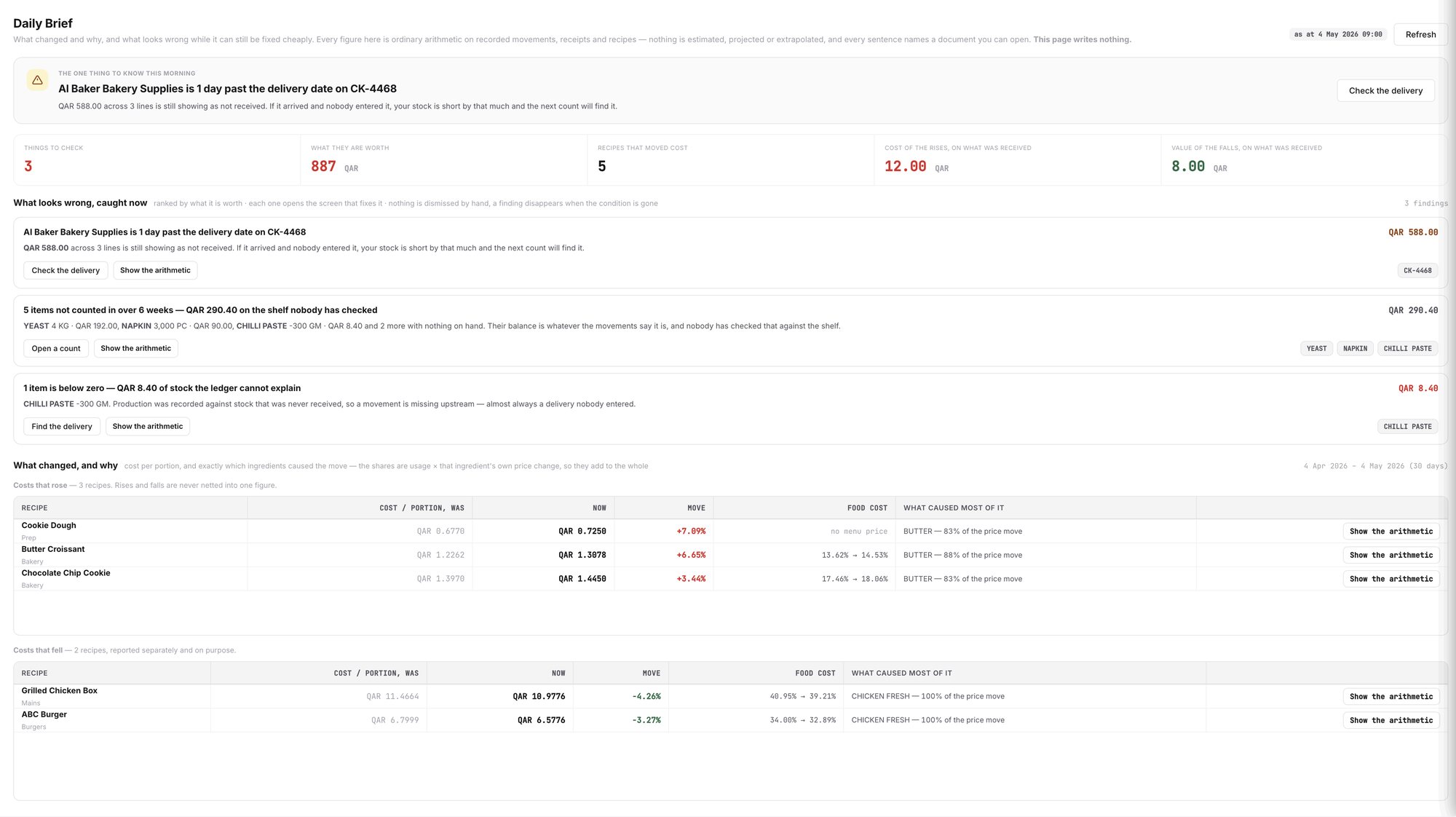
An example screen: the Daily Brief in Wady Central lists what looks wrong and which recipes moved cost, priced in riyals.
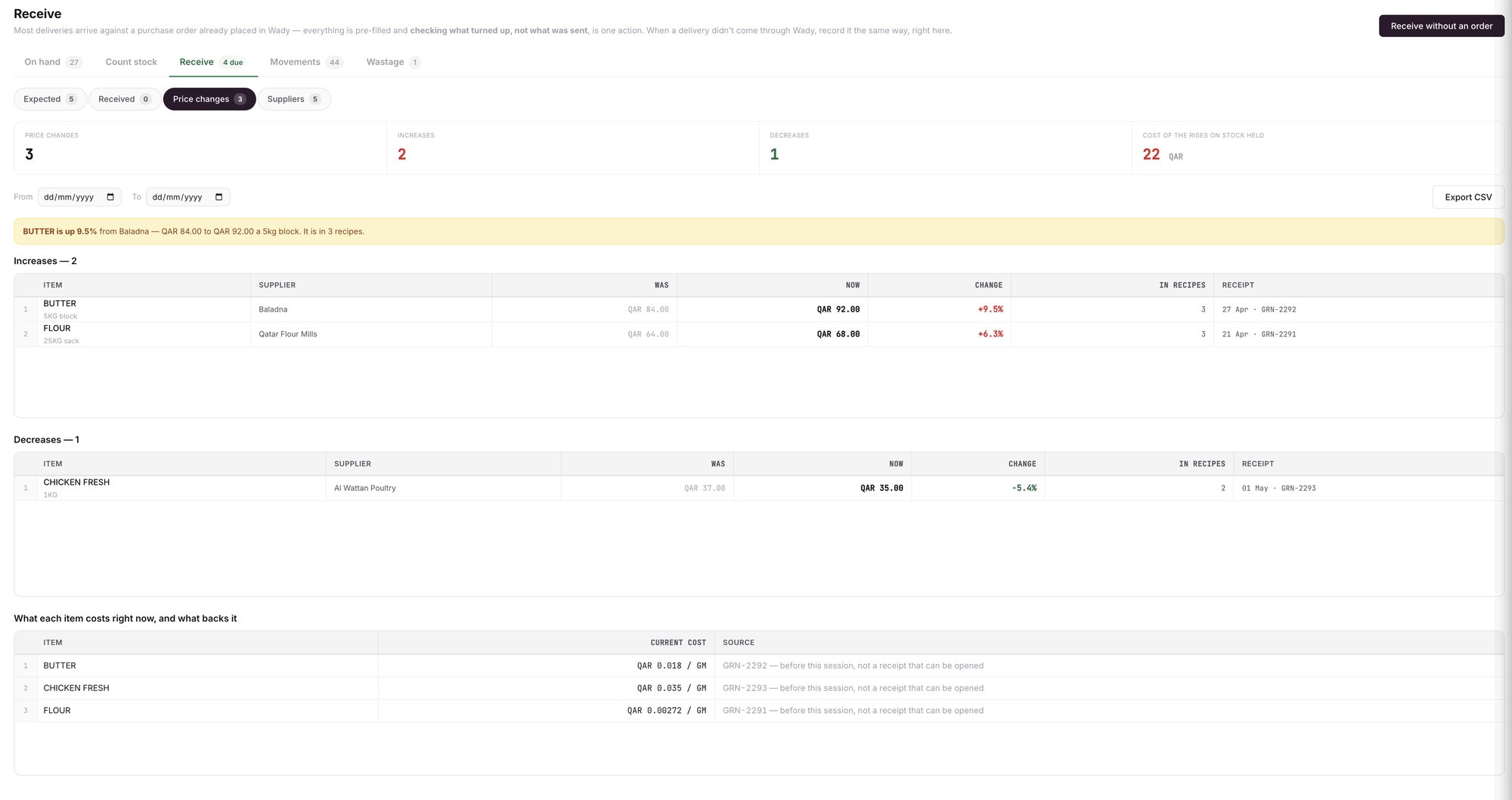
An example screen: the price changes view in Wady Central lists every rise and fall found at receiving, with the recipes each one touches.
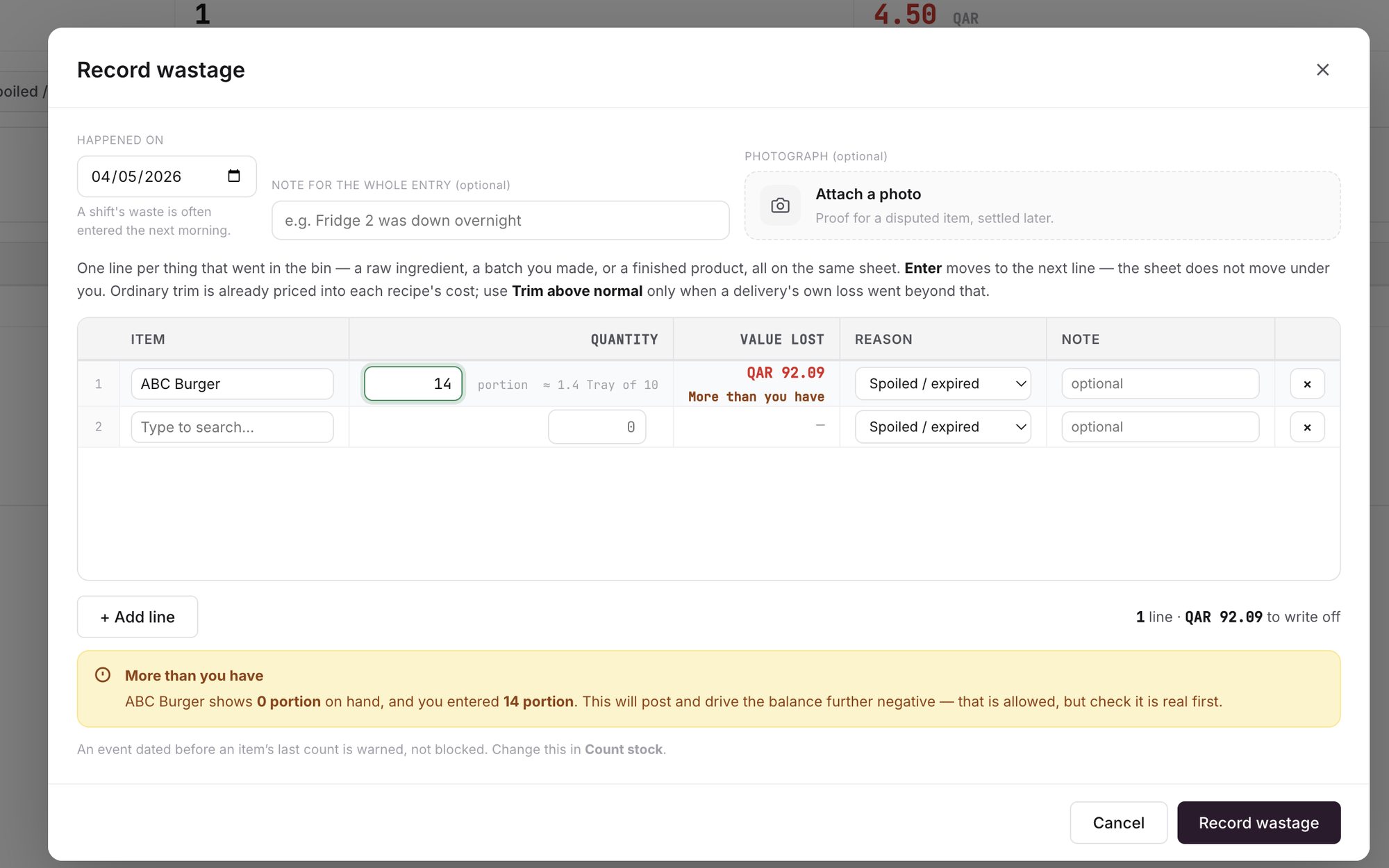
An example screen: a shift's waste goes into Wady Central in one entry, with the value lost and a reason for each line.

An example screen: unresolved deliveries to outlets stay listed in Wady Central until each difference is resolved.
What it does not do
Wady Central has no POS API connection yet, so it works alongside your POS. It is English only today, and an Arabic interface is planned. It does not run your accounting.
Who it is for
Wady works in Qatar today, and Wady Central fits any size of kitchen, from one cafe to a group with a central kitchen. See pricing.
The free Purchase System (order.wady.ai, App Store and Google Play) lets any restaurant, cafe, hotel or catering kitchen in Qatar order from all its suppliers in one app for free, and records what arrived and at what price. Elsewhere in the GCC, the practices above apply to you, and Wady is not available there yet.
Related articles
Theoretical vs actual food cost: what it is and how to close the gap
What is a central kitchen? A guide for restaurant groups in Qatar
See where your food cost leaks
Message us on WhatsApp at +974 7000 7658 for a Wady Central walkthrough, or read more on Wady Central. The free Purchase System is at order.wady.ai, on the App Store and on Google Play. Qatar only for now.
Frequently asked questions
Your kitchen's stock, recipes and costing, with numbers from real records.