Yield percentage is the usable weight of an ingredient divided by the weight you bought, times 100. Divide the price per kg by the yield to get the cost of one usable kg, and cost your recipe on that figure. This guide covers as-purchased weight against edible portion, the formulas with a worked example, cooking loss, and how Wady Central costs recipes.
Key takeaways
Yield % = usable weight / purchased weight x 100. Trim loss is the part you lose in prep.
Cost per usable kg = price per kg / yield, with yield as a decimal (75% is 0.75).
Cost a recipe on usable weight. Costing on purchase weight under-costs every dish that has trim.
In Wady Central, recipes are costed live from your purchase prices and yields, with sub-recipes, and show food cost and margin.
What is the difference between as-purchased weight and edible portion?
As-purchased weight (AP) is what you pay for. Edible portion (EP) is what is left to use after peeling, trimming, boning or cleaning. The difference is trim loss.
Term | Meaning | Formula |
|---|---|---|
As purchased (AP) | The weight on the invoice | |
Edible portion (EP) | The usable weight after prep | |
Trim loss | What you lose in prep: peel, bone, skin, stalks | AP - EP |
Yield % | The share of AP that is usable | EP / AP x 100 |
Ordinary trim belongs inside the recipe cost. Trim beyond the usual is waste, and it goes in a waste log. See how to track food waste.
How do you calculate yield percentage, step by step?
Weigh the purchase. Use the weight on your delivery note, checked on your scale.
Prep it your way. Peel, trim, bone or clean as the kitchen does for the dish.
Weigh the usable part and the trim. The two weights should add up to the purchase weight. A gap points to a weighing error.
Divide and multiply. Yield % = usable weight / purchased weight x 100.
Repeat on a few deliveries and average the results. Yield varies by supplier and by cook.
Two more formulas follow from it:
Trim loss % = 100 - yield %
Cost per usable kg = price per kg / yield (as a decimal)
Example: you buy 10 kg of whole fish at QAR 30 per kg, so QAR 300. After scaling, gutting and filleting, the fillets weigh 4.2 kg. Yield = 4.2 / 10 x 100 = 42%. Cost per usable kg = 30 / 0.42 = QAR 71.43. A 180 g fillet costs 0.18 x 71.43 = QAR 12.86, not the QAR 5.40 the invoice price gives.
How do you work out the cost of a dish from yield?
Cost each ingredient on its usable price, multiply by the amount on the plate, add the lines and divide by the portions.
Work out the cost per usable kg of each ingredient: price per kg / yield.
Multiply by the quantity the dish uses, in usable weight.
Add the lines, packaging and sauces included, and divide by the portions the batch makes to get the cost per portion.
Divide the cost per portion by the menu price, times 100, to get food cost %. See how to calculate food cost and menu pricing from food cost.
Example:
Ingredient | Price per kg | Yield | Cost per usable kg | In one portion | Line cost (QAR) |
|---|---|---|---|---|---|
Whole fish | 30.00 | 42% | 71.43 | 180 g | 12.86 |
Carrots | 4.00 | 80% | 5.00 | 100 g | 0.50 |
Parsley | 20.00 | 50% | 40.00 | 5 g | 0.20 |
The portion costs QAR 13.56. At a menu price of QAR 55.00, food cost is 13.56 / 55 x 100 = 24.7%. Costed on purchase weight, the same plate shows QAR 5.90 and 10.7%, which leaves out more than half the real cost. These numbers are an example.
What is cooking loss, and does it change the cost?
Cooking loss is the weight food loses while it cooks, from water, fat and shrinkage. It comes after trim loss. If your portion is a cooked weight, include it. If your portion is a raw weight that goes into the pan, cooking loss is already inside the portion.
⚠️ Watch out: Use one method across your recipes so you never count the same loss twice.
Cooking yield % = cooked weight / raw usable weight x 100
Cost per cooked kg = cost per raw usable kg / cooking yield (as a decimal)
Example: 1 kg of trimmed lamb comes out of the oven at 650 g, so the cooking yield is 65%. At QAR 60.00 per raw usable kg, a cooked kg costs 60 / 0.65 = QAR 92.31, and a 150 g cooked portion costs QAR 13.85.
How do you cost a recipe from yield in Wady Central?
Wady Central costs each ingredient on its yield, the usable amount after trim, from your real purchase prices, so cleaning loss sits in the price. The cost of a recipe is derived from its lines and recalculated every time an ingredient's price changes. See the recipes and costing feature.
Build a recipe
Open Recipes in the sidebar and click New recipe. The drawer says "Costed live on ingredient yield as you build it".
Under THE RECIPE, fill in Name and Portions this batch makes, the two required fields, and add a Category and a Chef if you use them.
Under INGREDIENTS & SUB-RECIPES, click + Add line, choose an ingredient or a sub-recipe, and type the quantity in USE. Each choice shows its current cost per unit. The line cost appears at once, and the cards at the top update: RECIPE COST, PORTIONS and COST / PORTION. If an ingredient is missing, click + New ingredient.
Tick Semi-finished under HOW THE OUTLETS GET IT for a sauce or dough that other recipes use. Other recipes then add it like any ingredient, and it carries a SEMI badge in the list.
Under MENU PRICE, type a price. The food cost % and the margin appear beside it.
Click Save recipe.
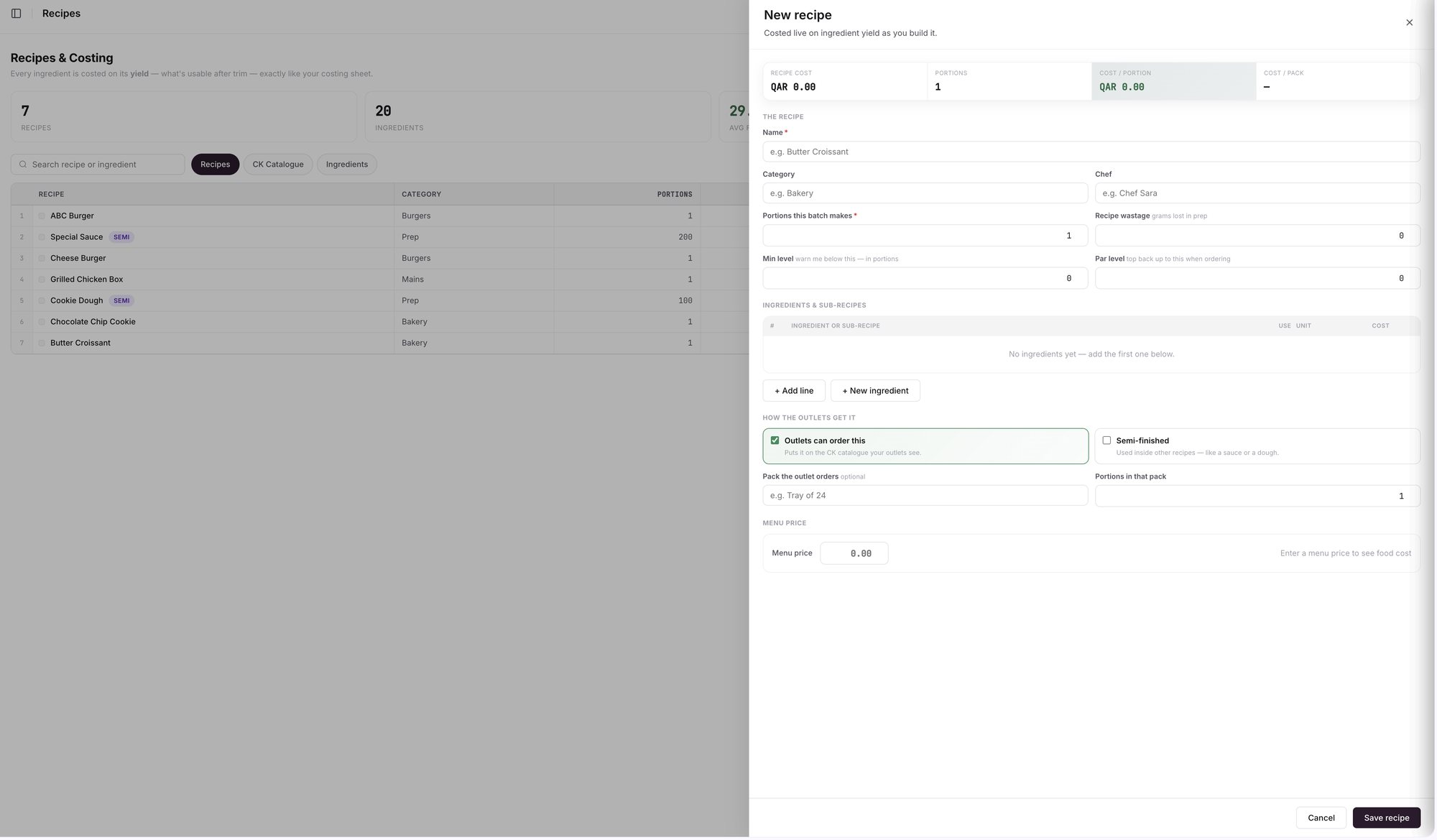
An example screen: the New recipe drawer, costed live as you add lines.
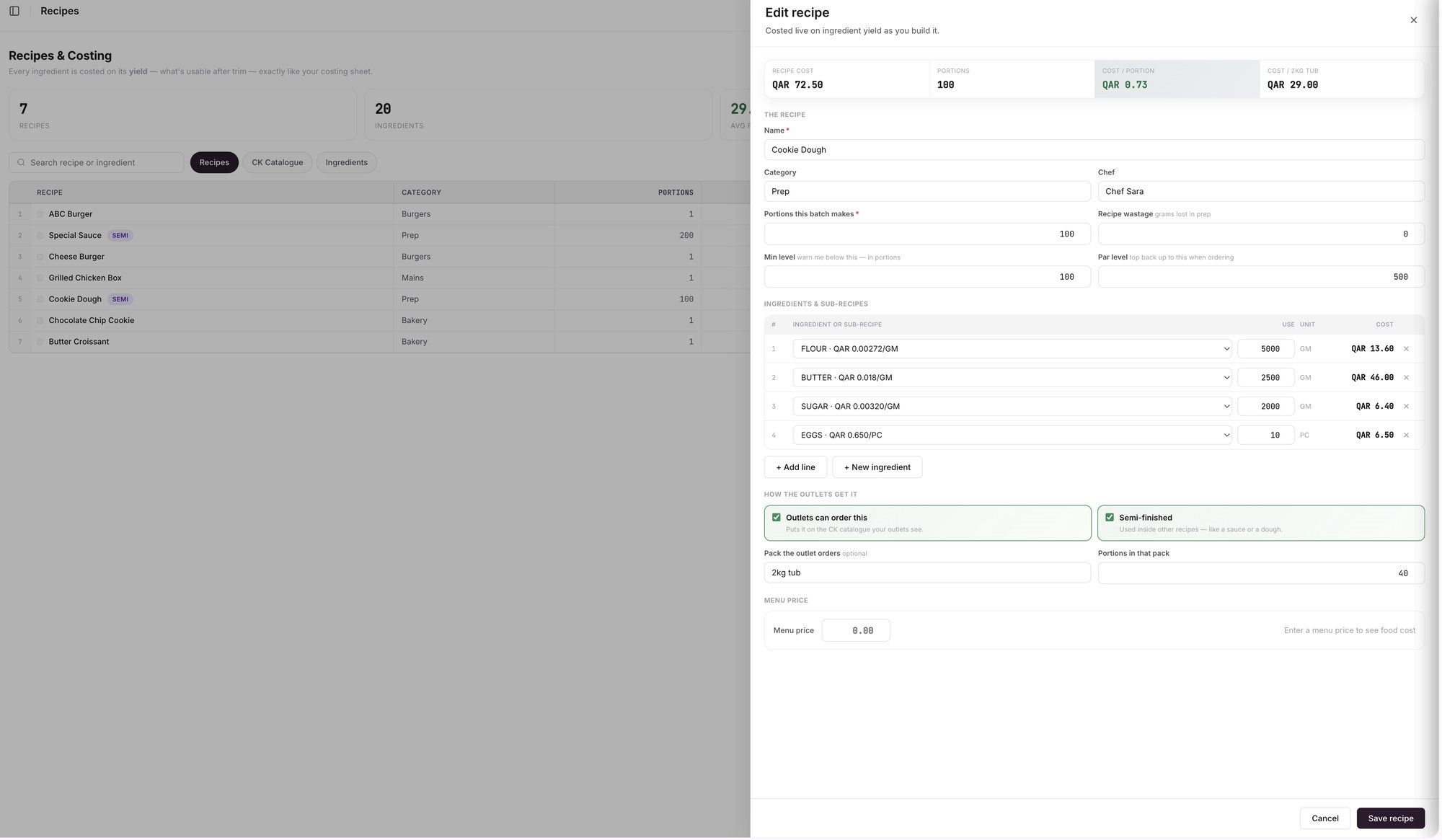
An example screen: a semi-finished recipe with its lines and cost cards.
Read how a recipe is costed
Click a recipe in the Recipes list to open its detail. The ingredient table shows QTY, PRICE, UNIT, USE IN RECIPE and COST for each line. If an ingredient loses weight in prep, a small note under its name shows the yield, such as "yield 900 of 1,000 GM": 900 g usable from 1,000 g bought. Below the table, the cards show RECIPE WEIGHT, RECIPE COST, PORTIONS and COST / PORTION.
The screen says the cost is derived: recalculated from the recipe's ingredients whenever one changes price, never typed in.
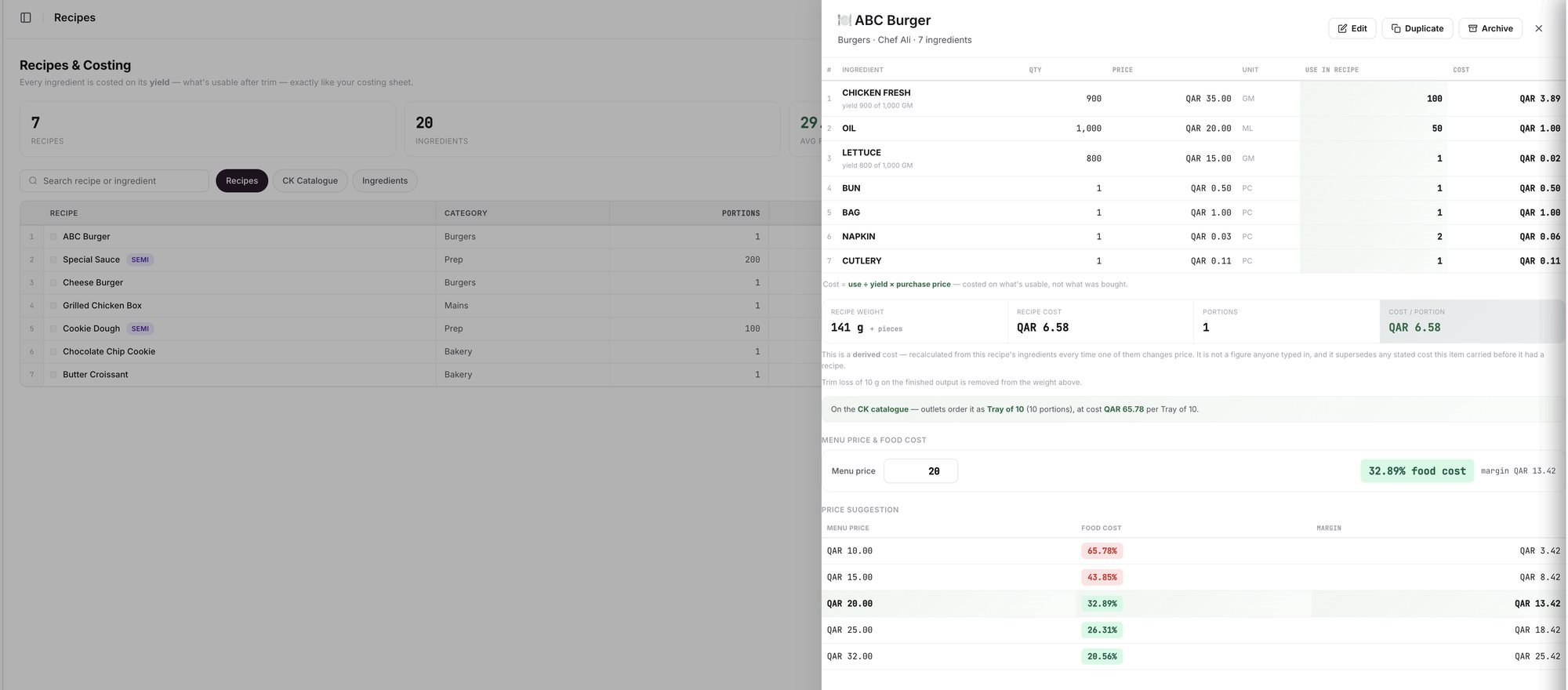
An example screen: a recipe's detail, with price, yield note and cost on each line.
See every recipe's cost
The Recipes list shows COST / PORTION, MENU PRICE and FOOD COST for each recipe. The cards above it show AVG FOOD COST and how many recipes sit over the food cost limit. The LINES column shows the number of lines and of sub-recipes, as in "8 · 1 sub". See food cost and margin for each dish.
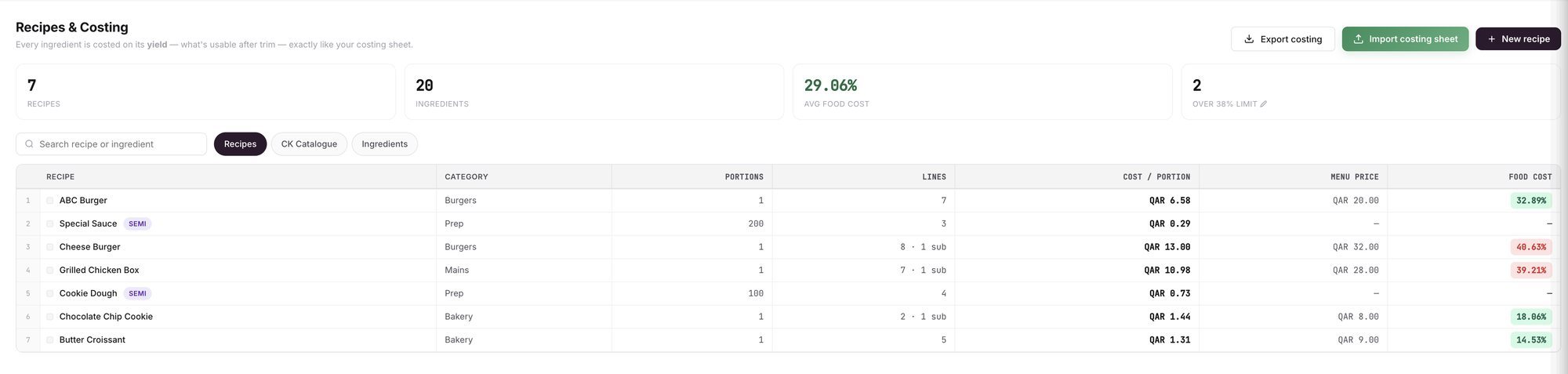
An example screen: every recipe with its cost per portion, menu price and food cost.
ℹ️ Tip: You can import your costing sheet, or build each recipe yourself with New recipe. See importing your costing sheet and how to set up your Wady Central account.
What does Wady Central not do?
It does not measure yield for you. Trim tests happen in your kitchen.
It does not connect to scales.
It does not rank your menu by what sells. It shows cost, food cost and margin per dish.
The interface is in English.
Related guides
Frequently asked questions
Did this guide answer your question?
Didn't find your answer?
Message us on WhatsApp or by email, and our team will get back to you.
Your kitchen's stock, recipes and costing, with numbers from real records.
More guides in this topic
How do I see each dish's food cost and margin?
How do I import my costing sheet?

