Can multiple brands operate from one central kitchen? A guide for Qatar
By Asaad Al Hashmi, Founder and CEO of Wady

Yes. One central kitchen can cook for several brands, and in Qatar the Ministry of Commerce and Industry's cloud kitchen guide names this setup the unified multi-brand model: one company runs the kitchen and produces food under several brand names. The kitchen, the staff and the equipment are shared. The hard part is the money: knowing what each brand costs when three brands use the same sauce.
This guide covers the two ways groups set it up, what the brands can share, how to cost a shared recipe per brand, and the mistakes we hear about most from kitchens in Qatar.
Key takeaways
One central kitchen can produce for several brands. Qatar's cloud kitchen guide calls one company cooking under several brand names the unified multi-brand model.
Brands can share the kitchen, staff, equipment, suppliers and base recipes such as sauces and doughs. Menus, dish recipes and orders stay per brand.
To cost a shared sauce per brand, cost the batch per gram, then count the grams each brand's dishes use.
Keep one ingredient and one base recipe for everyone. Copying the same ingredient once per brand splits your stock and your prices.
What does it mean to run several brands from one central kitchen?
It means one production kitchen prepares food that goes out under more than one brand name. A restaurant group might run a burger brand, a shawarma brand and a dessert brand, all fed by the same central kitchen. Some of those brands have dine-in branches. Others exist only on delivery apps.
The Ministry of Commerce and Industry's guide, summarised by the law firm Al Tamimi & Company in July 2025, describes two cloud kitchen models that matter here:
Unified multi-brand model: one company runs the whole kitchen and cooks under several brand names. The kitchen, staff and equipment are shared. It fits a group with its own brands.
Segmented model: the building is split into separate kitchen units, each leased to a different brand. Cleaning, logistics and maintenance are shared. It fits brands that want their own unit in a shared building.

In a multi-brand kitchen, one team cooks a batch once and portions it for every brand that uses it.
A central kitchen that also supplies dine-in branches works the same way as the unified model. The outlets order from the kitchen, the kitchen cooks once, and each brand gets its share. The basics of that loop are in what is a central kitchen.
What do you need in Qatar to run a multi-brand kitchen?
You need a company, a commercial registration and a trade licence, plus approvals from several ministries. According to the Al Tamimi summary of the guide:
Commercial registration with the Ministry of Commerce and Industry, under a food processing or catering activity.
Approvals from the Ministry of Municipality (urban planning), the Ministry of Interior's Civil Defence (fire safety and ventilation) and the Ministry of Public Health (food handling and hygiene).
A trade licence, which needs a valid lease for the premises.
Premises rules: not inside or connected to a residential unit, separate water, electricity and sewage networks, clear separation between preparation, cooking, storage and packaging, and a separate entrance for delivery riders.
The trade name and commercial registration number shown on the kitchen's front facade.
The ministries inspect cloud kitchens and can fine, suspend or close them. Rules change, so confirm the current requirements with the Ministry of Commerce and Industry before you sign a lease. For food safety, the Ministry of Public Health's food safety practices guide for food services covers traceability and recalls.
What can the brands share, and what has to stay separate?
Share everything that does not change what the customer gets. Keep separate everything that shows up on the plate, the bill or the brand's report.
Shared across brands: the kitchen, equipment and storage; the kitchen team; suppliers and purchasing; base recipes such as sauces, doughs, marinades and prep items; one stock list.
Kept per brand: the menu; the recipe of each dish; packaging and labels; orders from each brand's outlets; cost and margin per brand.
Shared purchasing is where the savings start. One order to the vegetable supplier covers every brand, and you see one price for each item. If you run outlets for several brands, how multi-branch restaurants centralize purchasing goes into the ordering side.
How do you work out the cost per brand when brands share a sauce?
Cost the shared batch once, turn it into a cost per gram, then let each brand's dish recipe pull the grams it uses. The sauce stays one recipe. The brand cost comes from the dishes.
A worked example. All numbers below are examples.
Cost the batch on usable yield. A garlic sauce batch costs QAR 120 in ingredients and gives 10 kg of usable sauce. That is QAR 12 per kg, or QAR 0.012 per gram.
Put the sauce inside each dish recipe as a sub-recipe. Brand A's shawarma wrap uses 30 g, which is QAR 0.36. Brand B's chicken burger uses 20 g, which is QAR 0.24.
Add the rest of each dish. The wrap's other ingredients cost QAR 3.64, so the wrap costs QAR 4.00 in food.
Multiply by what each brand sold. If Brand A sold 2,000 wraps this month, the sauce cost Brand A QAR 720 and the whole wrap cost QAR 8,000 in food.
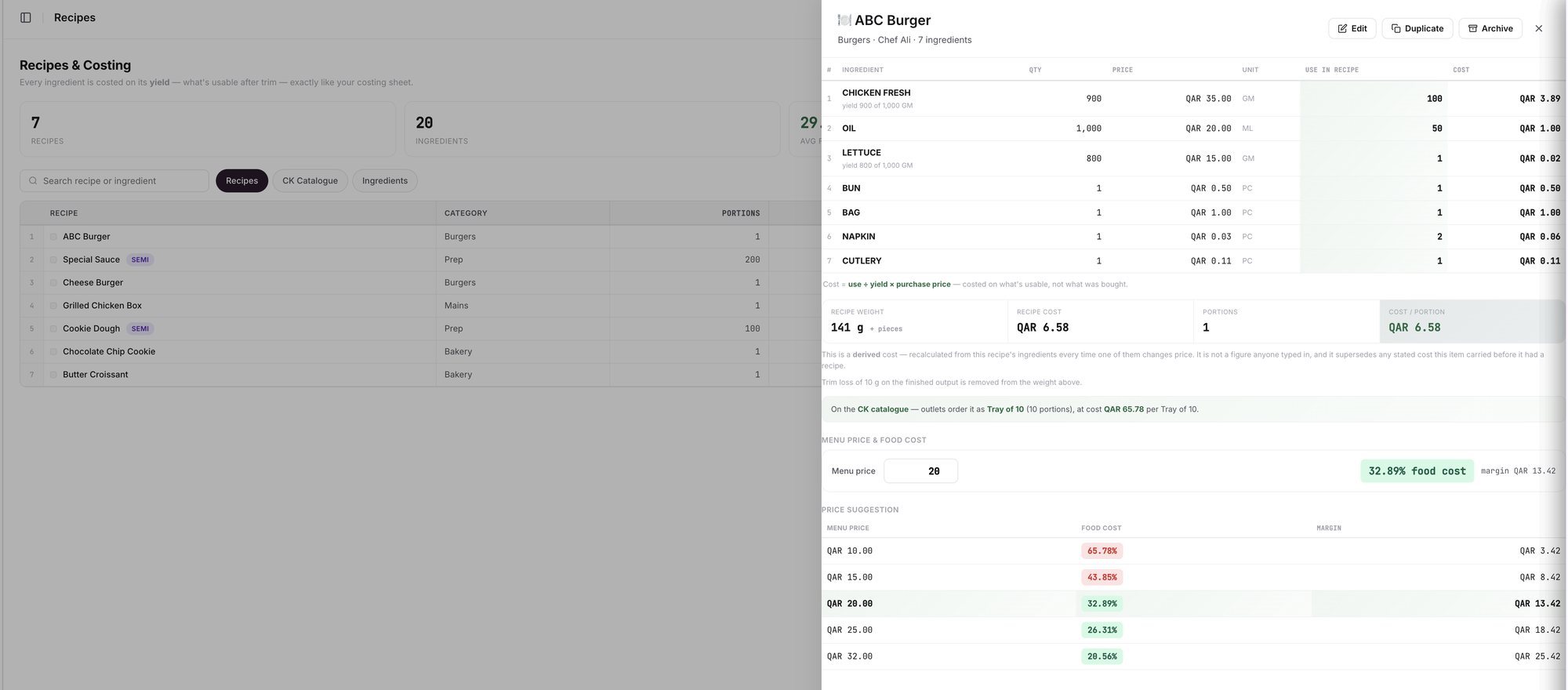
An example screen from Wady Central: Special Sauce is a semi-finished recipe used inside other recipes, and the burger's cost is built from its ingredients.
Your sales numbers come from your POS or the delivery apps, one report per brand. The food cost formula itself is in how to calculate food cost.
Rent, electricity and the kitchen team are a separate question. Accountants split them with one rule per cost, for example by each brand's share of orders, and keep the same rule every month so the months compare.
The "100 sugars" mistake
A cost controller at a Qatar group with many brands and one central kitchen told us their system kept one master list of ingredients. To see which brand made money, the team created a separate copy of each ingredient for every brand. Sugar existed many times over.
It worked on paper, and it caused new problems:
An outlet could pick the wrong brand's item or supplier.
A supplier price changed on one copy and not on the others.
The stock count split one shelf of sugar into many lines.
Keep one ingredient and one base recipe. Let each brand's dish recipes and orders carry the brand.
How do orders and deliveries work when one kitchen cooks for several brands?
Each brand's outlets order from the kitchen, the kitchen adds up all the demand, cooks once and sends each outlet its share. Brand B's sauce and Brand A's sauce come out of the same pot, and the delivery note tells each outlet what it received.
A working day looks like this:
Outlets order from the kitchen, each under its own name.
The kitchen sees all demand on one sheet, by product or by outlet.
Production plans from real orders, minus what is already in stock.
Dispatch packs each run with a picking list and a delivery note.
Each outlet confirms what arrived, so nothing is left in the air.
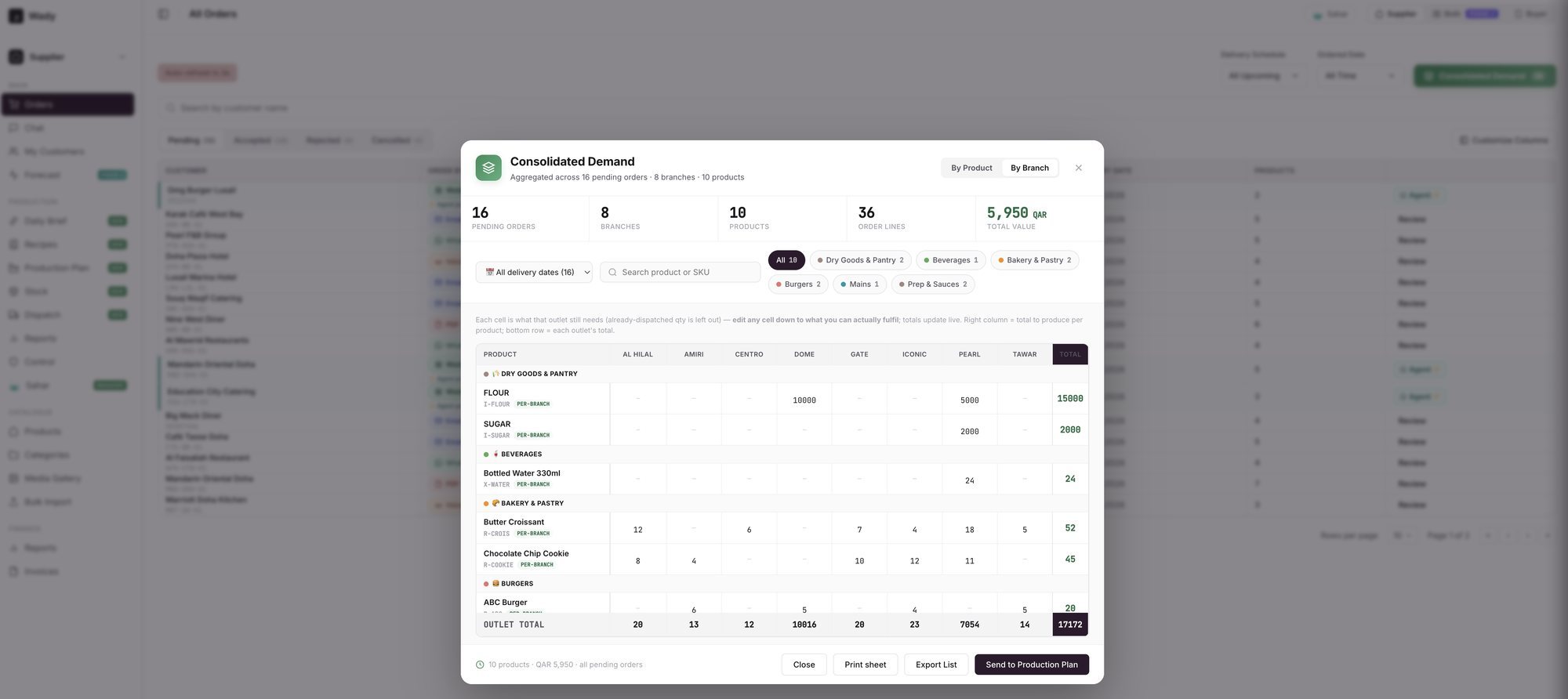
An example screen from Wady Central: Consolidated Demand puts every outlet's order on one sheet, by product and by branch, with totals.
Delivery-only brands work the same way when you treat each brand's delivery operation as its own outlet in the kitchen's records.
What goes wrong most often in a multi-brand kitchen?
The same problems we hear about in single-brand kitchens get bigger, because one mistake now touches several brands at once.
Orders retyped every night. Someone rewrites every outlet's order into one sheet, then retypes it as transfers.
One wrong digit spreads. One operator typed 336 as 0.336. Every report after it was quietly wrong, for every brand using that item.
A price rise moves several menus. When butter or chicken goes up, every brand's dishes that use it cost more, and you often find out when the invoices arrive.
Transfers left open. The kitchen sends and closes its side. The outlet never confirms. Stock disappears from the kitchen and never appears at the outlet.
Rush hours collide. Two brands peak at lunch on the same line. Plan prep by brand as well as by item.
How Wady helps with running several brands from one kitchen
What Wady Central does
Wady Central is Wady's paid system for groups, central kitchens and catering companies in Qatar. Every brand, branch and kitchen sits in one account.
Outlet orders: outlets order from your kitchen in the app, and every order is recorded with who placed it and when. See outlet orders.
One demand sheet: all demand on one sheet, by product or by outlet, showing only what is still needed.
Production: plan from real orders minus stock, with sub-recipes pulled in and rounded to real batches. See production.
Recipes and costing: costed on usable yield after trim, with sub-recipes and food cost %, re-costed the moment a supplier price moves. See recipes and costing.
Dispatch: picking lists, a signable delivery note for every run, and outlets confirm arrival in the same app. See dispatch.
Outside clients: your kitchen can also sell to outside clients, with their own prices, invoices and delivery notes.
What it does not do yet
Profit per brand. Wady Central does not show a profit report per brand. Your sales per brand stay in your POS and the delivery apps.
POS and delivery app connection. It works alongside your POS and accounting and does not connect to them directly.
Roles per brand. It does not yet hide one brand's recipes or costs from another brand's staff.
Arabic. Wady Central runs in English for now. An Arabic interface is planned.
Who it is for
Groups that cook for more than one brand or branch from a central kitchen, and catering companies that also sell to outside clients. Over 100 businesses in Qatar already use Wady, including Crave Holdings and OMC. For plans, see the pricing page. For the inventory side, read central kitchen inventory software.
FAQ about running multiple brands from one central kitchen
Is a multi-brand kitchen the same as a cloud kitchen?
A cloud kitchen sells only through delivery and ordering apps, with no dine-in. A multi-brand central kitchen can supply dine-in branches, delivery-only brands, or both. Qatar's cloud kitchen guide covers the delivery-only case.
Does each brand need its own licence in Qatar?
The guide licenses the company and the kitchen premises. In the unified multi-brand model, one company produces under several brand names from one licensed kitchen. Confirm your own case with the Ministry of Commerce and Industry.
How do I know which brand makes money?
Cost each dish from its recipe, including its share of shared sauces, then multiply by what that brand sold. Food cost comes from your recipes. Sales come from your POS and delivery apps.
Should I create a separate ingredient for each brand?
No. One ingredient and one base recipe keep one price, one stock line and one count. Each brand's dish recipes carry the brand.
Can the central kitchen also sell to outside clients?
Yes. In Wady Central, outside clients order from your kitchen in the Wady app, with their own prices and catalogue, and you issue invoices and delivery notes.
Related articles
See it on your own setup
Running more than one brand from one kitchen? See how Wady Central handles your outlets, your recipes and your suppliers in one account. A walkthrough on your own setup takes 20 minutes.
Your kitchen's stock, recipes and costing, with numbers from real records.


