Why restaurants over-order, and how order history fixes it
By Asaad Al Hashmi, Founder and CEO of Wady

Restaurant over-ordering comes from four habits: ordering extra for fear of running out, buying a supplier's full minimum or pack size, sending orders from memory on WhatsApp, and keeping no record of what the kitchen used last week. In UK hospitality and food service, almost one fifth of the food the sector buys is thrown away, according to WRAP in 2024. The fix is to order from what you used, not from what you ordered last time.
It is 11 at night. The head chef types tomorrow's order to the supplier on WhatsApp from memory, then adds one more crate of tomatoes, just in case. By Thursday, half that crate has gone soft at the back of the walk-in. He did nothing wrong: he was protecting tomorrow's service, and the fear of running out is fair. The guess is the problem, and a record of what the kitchen used can replace it.
Below: the six causes, the real cost, a five-step method to set par levels from your order history, and what to do with supplier minimums.
Checked October 2026.
We are Wady. We make the free Purchase System and Wady Central for kitchens in Qatar, so the last part of this guide shows where Wady helps with ordering and where it does not.
Key takeaways
Kitchens over-order for fear of running out, because of supplier minimums and pack sizes, because orders go out from memory, and because nobody recorded last week's use.
UK hospitality and food service throws away almost one fifth of the food it buys, according to WRAP in 2024.
In a UK study (2011 data), food purchases and labour made up over 90% of the cost of food waste, and disposal just over 3%.
To order the right amount, compare what you ordered with what you used over 4 to 8 weeks, then set each par level from real use plus a small buffer.
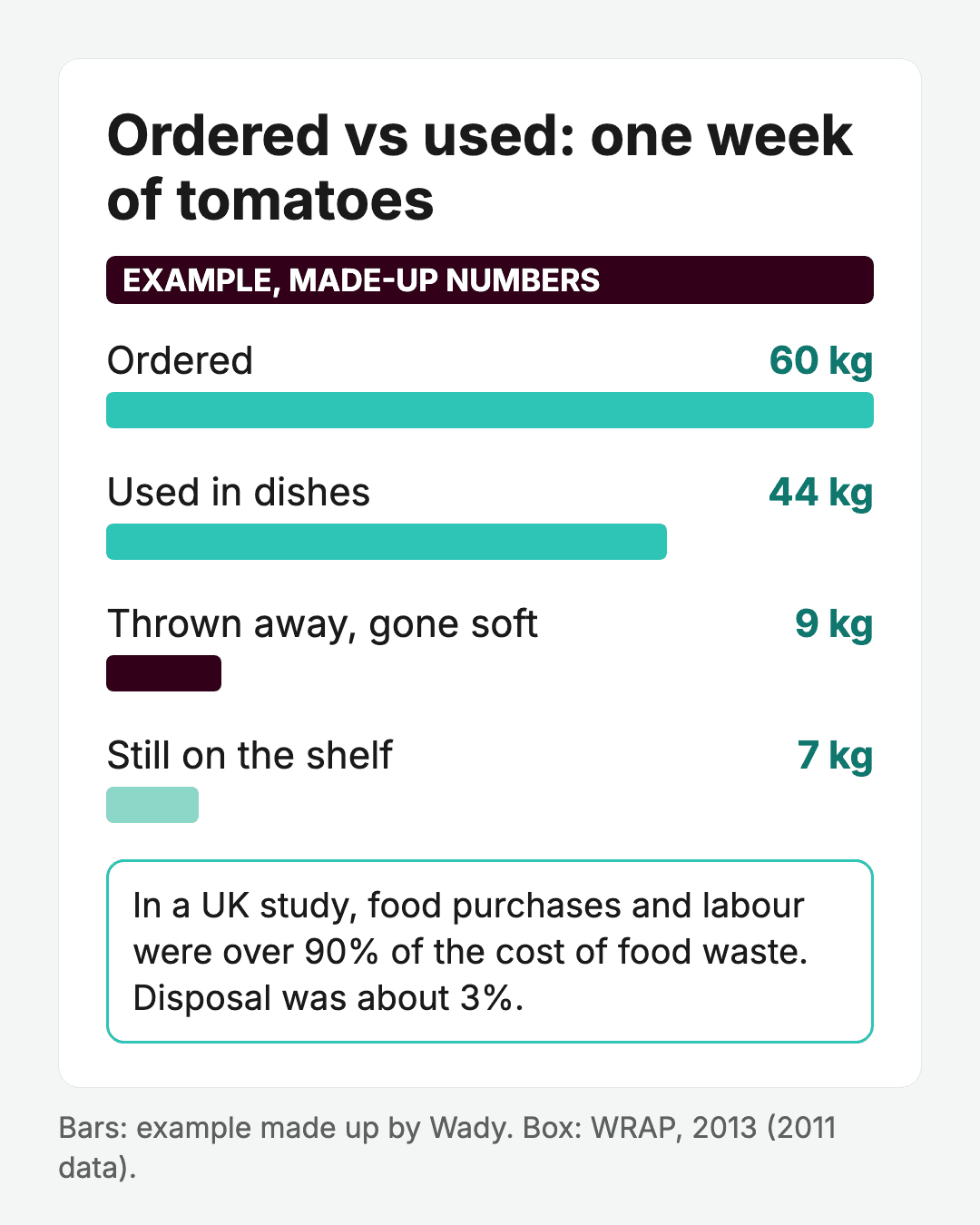
Example, made-up numbers: a kitchen orders 60 kg of tomatoes in a week, uses 44 kg in dishes, throws away 9 kg and still has 7 kg on the shelf.
Why do good kitchens order more than they need?
Good kitchens over-order because running out mid-service feels worse than throwing food away, and because the ordering setup pushes them to buy more. Six causes explain most of it.
Fear of running out
A chef who runs out on a busy night takes a dish off the menu and faces disappointed guests, so extra stock feels like insurance. Pirani and Arafat's study of 45 hotels and restaurants in Abu Dhabi found that how accurately a kitchen predicted its customer numbers was a main driver of its food waste (Journal of Cleaner Production, 2016).

A 2016 study of 45 hotels and restaurants in Abu Dhabi linked food waste to how accurately kitchens predicted their customer numbers.
Supplier minimums and pack sizes
A supplier may sell tomatoes only by the crate, or deliver only above a minimum order, so you buy more than you need to get the delivery. A 2019 review by Filimonau and De Coteau notes that suppliers can dictate "the volume and the frequency of food deliveries" (Tourism Management, 2019). WRAP's UK study found that bulk packs suit only products "used regularly at larger outlets where the chance of spoilage is minimal" (WRAP, 2013).
One item waits for another
When one ingredient arrives late, the others sit and age. A central kitchen buyer in Qatar told us in a meeting: "We have A but are waiting for B, and A expires."
Ordering from memory on WhatsApp
After service, the person ordering types quantities from memory into a chat, with last week's order buried in the thread, so they round up. See ordering from suppliers on WhatsApp vs one app.
No record of last week's use
Kitchens know what they ordered, but without counts nobody can tell whether the 60 kg went into dishes or the bin. WRAP's UK study found that chilled supplies "over-ordered because of inaccurate demand forecasting" are likely to increase waste (WRAP, 2013).
Par levels that only go up
A par level is the amount you want on the shelf after a delivery. Someone runs out once and raises it, and nobody lowers it after a quiet month. Our guide to par levels and reorder points explains both terms.
What does restaurant over-ordering really cost?
Over-ordering costs you the food first, then the labour, and little for the bin. UK hospitality and food service wastes 1.1 million tonnes of food a year, 75% of it edible, at a cost of £3.2 billion (WRAP, 2024).
The cost is the food you bought
A UK study, with 2011 data, put the sector's food waste cost at £2.5 billion a year. Food purchases came to £1,340 million and labour to £960 million, over 90% of the total. Waste management was just over 3% (WRAP, 2013). A cheaper bin contract saves little; buying less of what you throw away saves the most.
Food that spoils before anyone cooks it
In the same study, about a fifth of the food wasted at outlets spoiled before it reached a pan. Worldwide, restaurants, hotels and caterers made up 28% of the food wasted at consumer level in 2022, about 290 million tonnes (UNEP, 2024).

In a UK study with 2011 data, about a fifth of the food wasted at hospitality outlets spoiled before anyone cooked it.
Cash sitting on the shelf
Picture a cafe owner who opens a month of orders and sees she bought milk five times a week but used enough for four. Ordering less costs her no quality and gives her back cash that sat in the fridge.
Why is copying last week's order not the answer?
Last week's order shows what you bought, extra crate included. Copy it and you copy the guess. Charlebois, Creedy and von Massow found that managers mostly discovered waste at weekly inventory checks, when the cause was already hard to trace, and that company-wide supplier agreements stopped chefs from changing their orders (IJCTHR, 2015).
Order history helps once you set it next to your counts: orders show what came in, counts show what left.

A 2015 restaurant study found that managers mostly discovered waste at weekly inventory checks, when the cause was already hard to trace.
How do you order from real use?
Compare what you ordered with what you used, item by item, then set each par level from use. Start with your ten most costly items.
1. Pull 4 to 8 weeks of orders per item
List each item's orders: date, quantity, price, supplier. From WhatsApp chats, this is the slow part.
2. Count opening and closing stock
Count the same items at the start and end of each week, in the same units. See how to do a stock count.
3. Work out what you used
What left the shelf = opening stock + what you received - closing stock. Subtract the waste you logged to see what went into dishes. When the numbers do not match, check stock count variance.
4. Compare ordered with used, and set the par
Set the par from use between deliveries plus a small buffer, then order the par minus the usable stock on the shelf, minus anything already ordered and not yet delivered. Example, made-up numbers: 44 kg of tomatoes a week over two deliveries is about 22 kg each time. A par of about 25 kg leaves a buffer, so with 6 kg on the shelf and nothing on the way you order 19 kg.
5. Match delivery frequency to shelf life
Fresh produce and dairy suit smaller, more frequent deliveries; dry goods can come less often. A 2019 Champions 12.3 report suggests agreeing a delivery schedule with suppliers based on historical trends and waste data (Champions 12.3, 2019). The same report found restaurants saved about $7 for every $1 invested in cutting food waste.
To start with the bin side, run a one-week food waste audit.
What should you do with supplier minimums?
Treat a supplier's minimum as a total for the whole order. Four moves help:
Combine items: fill the minimum with weekly items from the same supplier, such as dry goods, not extra fresh stock.
Ask for a smaller pack: a steady customer can ask for half crates or smaller cases.
Ask for other delivery days: show the supplier your order history and agree days that fit your use.
Switch low-use items to frozen: WRAP's study points to frozen ingredients as an option where chilled stock gets over-ordered.
How Wady helps with ordering the right amount
Wady keeps the order and stock records the five steps need, so you stop rebuilding them from chats. Over 100 businesses in Qatar already use Wady.
For us this is more than software. Our mission is to cut food waste in the Gulf by digitizing the order between a kitchen and the suppliers it already buys from. Our vision is a Gulf food supply chain where every order is visible, so suppliers and kitchens see demand before it arrives, order what will be used, and throw less away. Food grown for what people will eat, not for a guess. The supplier loads what kitchens order, and the farmer grows what suppliers buy, so an order that matches real use means fewer tomatoes grown to be thrown away. One tomato's story shows where it gets lost along the way.
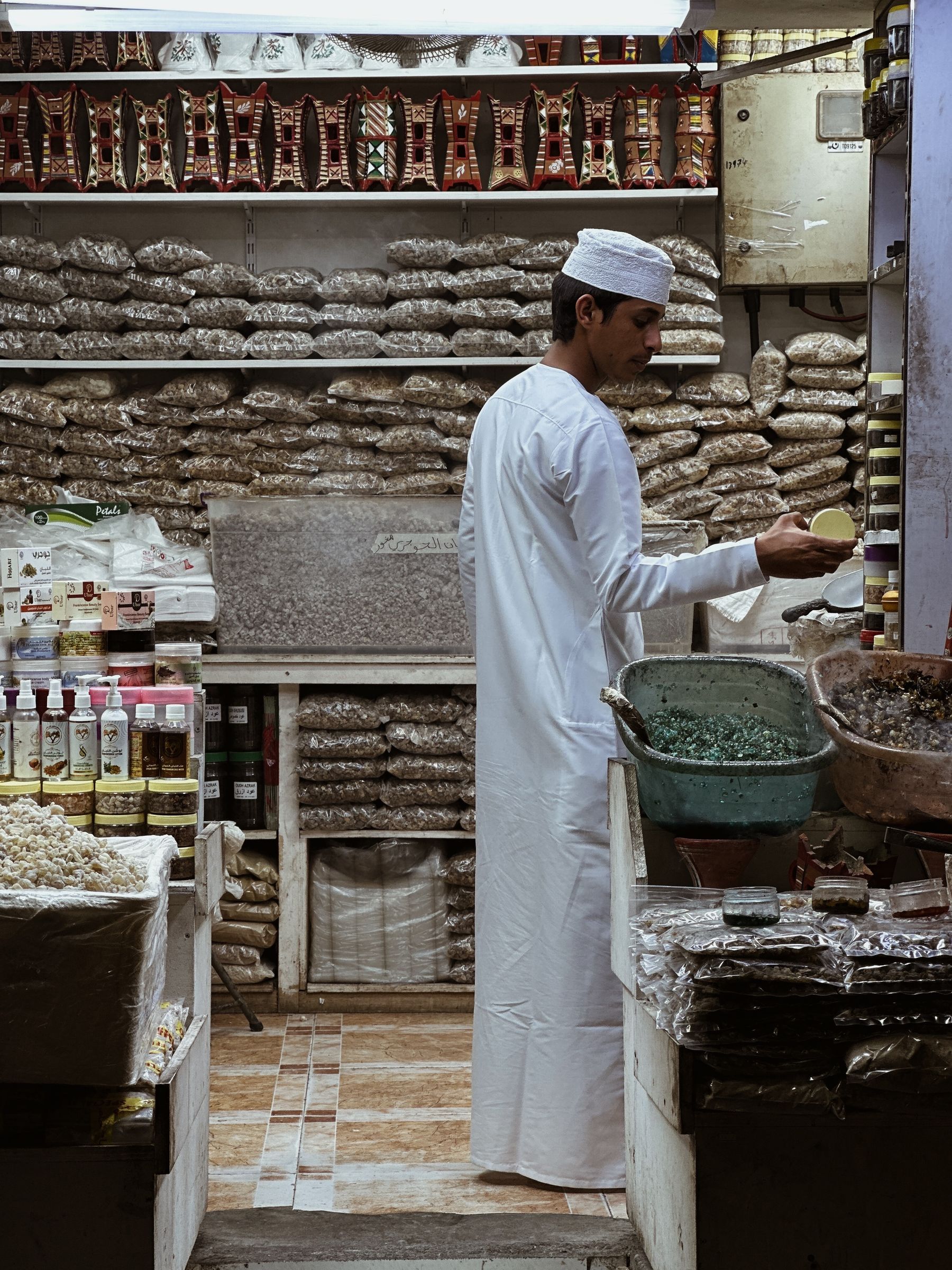
A man in a white thobe picks spices at a traditional market shop, one of the places where food starts its way to a kitchen.
What it does
Order history (Purchase System, free): every order saved with its items, quantities and prices, a history you can search any time, and spend per branch and per supplier. See the Purchase System.
While you order: minimum order and pack size shown as you add, the supplier's delivery days and cut-offs, favourites for what you reorder, and who placed each order.
Counts and waste (Wady Central): count on paper or on screen, in sacks and grams; log a shift's waste in one entry with your reasons; see waste cost by period, reason and item. See counts and waste.
Stock levels (Wady Central): min and par levels you set, with low-stock alerts and the cost to refill.
Production and purchasing (Wady Central): plan production from real orders minus what is in stock, and get a purchase list built from that plan. See purchasing.
What it does not do
Wady does not reorder for you from par levels or forecast sales. You set the pars, and every figure Wady shows is arithmetic on your real records. Wady Central has no POS API connection yet, so it works alongside your POS.
Who it is for
Restaurants, cafes, hotels and catering kitchens in Qatar, from one cafe to a group with a central kitchen. Wady works in Qatar only for now.
Related articles
How much food does Qatar waste? The sourced numbers and where waste starts
How to measure food waste in a restaurant kitchen: a step-by-step waste audit
Order what your kitchen uses
Message us on WhatsApp at +974 7000 7658 for a Wady Central walkthrough, or read more on Wady Central. The free Purchase System is at order.wady.ai, on the App Store and on Google Play. Qatar only for now.
Frequently asked questions
All your orders from your suppliers in one place, free forever.


