Ramadan food waste in Qatar: why so much is left over, and how to plan better
By Asaad Al Hashmi, Founder and CEO of Wady

Ramadan food waste in Qatar is measured in homes: 25% of the food prepared at home in Ramadan goes to waste, according to a 2022 household study in Doha reported by UNEP's GO4SDGs platform in 2024. Restaurants and hotels have no national Ramadan figure yet, but hotel iftar pilots in Doha and the Gulf show that smaller trays and planned refills cut waste. The generosity of Ramadan is fine. The guessing is what we can fix.
It is 6:10 pm and the adhan is minutes away. A mother has set extra dishes because her brother said he might bring his family. He calls: they are staying home tonight. After isha, the tray of harees goes back into the fridge, and two days later into the bin. Nobody did anything wrong. The table was planned on a "might".
Below: the sourced numbers, why waste rises in the holy month, what hotels changed at iftar, and how kitchens, suppliers and families can plan.
Checked October 2026.
We are Wady. We make the free Purchase System and Wady Central for kitchens in Qatar, so the last part of this guide shows where Wady helps with Ramadan planning and where it does not.
Key takeaways
In Ramadan, 25% of the food prepared in Qatar's homes goes to waste, according to the 2022 Doha household study (reported by UNEP's GO4SDGs, 2024).
A 2023 Sustainable Ramadan pilot cut food waste by an average of 61% across three hotels, one of them in Doha.
In Hilton's 2025 Green Ramadan across 45 hotels, plate waste fell from 87 g to 64 g per cover, a 26% cut (Hilton, 2025).
Hifz Al Naema received about 4,371 iftar meals a day in Ramadan 2025, by the centre's own figures, so safe surplus has a place to go.
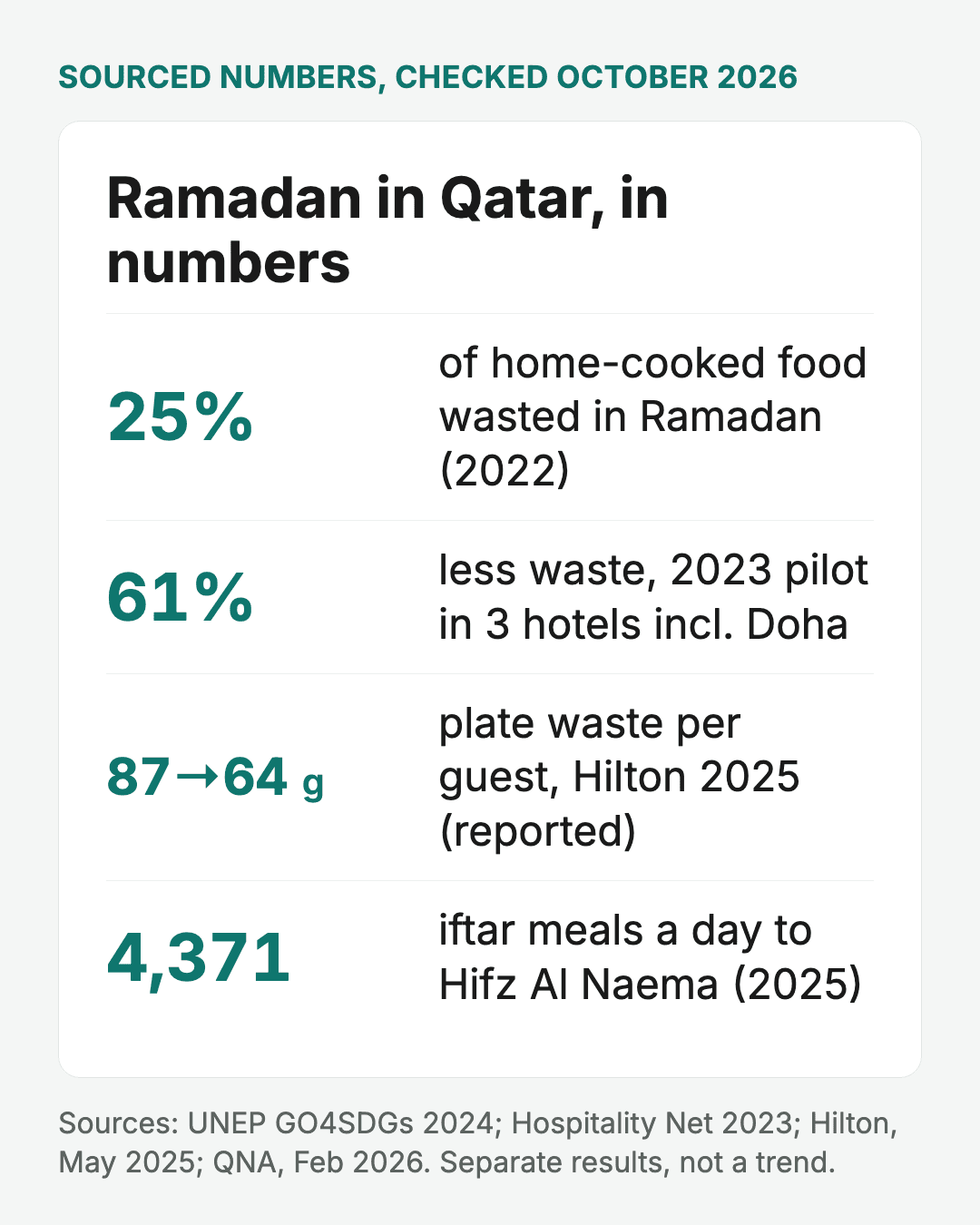
Ramadan in Qatar in numbers: 25% of food prepared at home wasted, a 61% cut in a 2023 hotel pilot, 87 g to 64 g plate waste per cover, and about 4,371 iftar meals a day received by Hifz Al Naema.
How much food is wasted in Ramadan in Qatar?
In Ramadan, 25% of the food prepared in Qatar's homes goes to waste. That is the only measured Ramadan figure for Qatar we found, and it covers homes.
Where it comes from: a 2022 household study in Doha by the Ministry of Municipality with UNEP's West Asia office, as reported by GO4SDGs in April 2024.
How it fits the year: the same study put household waste at about 93 kg per person a year, and one of its two rounds ran in Ramadan (UNEP, 2024). See how much food Qatar wastes.
What it leaves out: restaurants, hotels, caterers and suppliers. Nobody has published a national Ramadan figure for them.
Bigger Ramadan percentages circulate online; we left them out because none names a study we could open.
Why does more food go to waste in Ramadan?
More food goes to waste in Ramadan because tables are planned for the guests who might come, shopping happens hungry, and buffets are built to look full until the last guest leaves.
Many dishes for one table
A host shows care with variety, and each extra dish adds a portion that may come back untouched.
Shopping while fasting, and in bulk
A list written at 3 pm on an empty stomach runs longer than one written after iftar, and big trips before the month fill the fridge with fresh items nobody cooks in time.
Guest numbers nobody confirms
The count stays open until the last minute, so kitchens cook for the top of the range "just in case".
Buffets built to look full
A buffet that looks thin at 8:30 pm worries the team, so trays get topped up to closing, and food left on display cannot go back to the kitchen.
One big order before the month
Some kitchens place one month-sized order on a guess, and short-life produce waits in the cool room while real demand turns out different.
What have hotels in Doha and the Gulf changed at iftar?
Hotels that ran Ramadan waste programmes served smaller portions, cooked at live stations, refilled in small batches and measured waste every day.

Hotels that cut Ramadan waste refilled buffets in small batches, and a 2023 pilot including a Doha hotel cut food waste by an average of 61%.
Sustainable Ramadan 2023: three hotels, one in Doha
In 2023, a Sustainable Ramadan pilot cut food waste by an average of 61% across three hotels: Waldorf Astoria Lusail in Doha, Conrad Dubai and Hilton Riyadh (Hospitality Net, July 2023; GO4SDGs, 2024). The teams served smaller portions, cooked at live stations and kept displays modest. In 2024, the Sustainable Ramadan campaign ran a second edition in 32 Hilton hotels in 7 countries (GO4SDGs, April 2024).
Green Ramadan 2025: 45 hotels, plate waste per cover
In 2025, Hilton ran Green Ramadan with UNEP West Asia in 45 hotels in 14 countries. Plate waste fell from 87 g to 64 g per cover over the month, a 26% cut (Hilton, May 2025; UNEP, March 2026). The measures: guest messaging, smaller portions, live cooking stations, efficient food displays and set menus.
The two results measure different things: the 2023 pilot counted total food waste in three hotels, and 2025 counted what guests left on the plate in 45 hotels. Read them as two separate lessons, not as a trend.
How can a restaurant or hotel plan iftar covers and buffet size?
Plan iftar from confirmed covers and last year's use, cook in batches, refill small, and weigh what comes back every day.
1. Start from confirmed covers
Take confirmed bookings, add walk-ins from the same week last Ramadan if you recorded them, and plan the buffet for that number with a small buffer.
2. Set a quantity per cover for each dish
Write down how much of each dish you plan per guest, so every quantity moves when the guest count changes.
3. Cook in batches and refill in small trays
Hold part of each dish back and send it out as trays empty, in smaller trays after the first rush.

In Hilton's 2025 Green Ramadan, smaller portions and set menus helped bring plate waste down from 87 g to 64 g per cover.
4. Record tray and plate waste every night
Weigh what comes back from buffet and plates, with a reason, and divide by covers to compare a quiet night with a busy one. See how to track food waste.
5. Donate safe surplus
Safe food never put out for guests can go to Hifz Al Naema Centre, which collects surplus for people in need. Its executive director told QNA the centre received about 4,371 iftar meals a day last Ramadan and served about 127,359 fasting people over the month, by the centre's own figures (QNA, February 2026).
How should caterers and suppliers order for Ramadan demand?
Order Ramadan stock week by week from real use, share the plan with your suppliers, and check short-life items twice a week.

Short-life produce ordered for a whole month on a guess can spoil before day ten, so weekly orders from real use keep it fresh.
At dawn, a vegetable supplier loads crates for an order sized for the whole month. By day ten, half the coriander has turned yellow. The supplier did the job, the kitchen paid, and the herbs went in the bin.
Order weekly, not monthly: compare last week's order with last week's use, and order the gap.
Plan production from orders minus stock: a central kitchen feeding outlets can plan each day's batches from what the outlets ordered, minus what is already made. See the daily production plan for a central kitchen.
Tell your suppliers early: share the menu and expected covers before the month.
Count short-life items twice a week: herbs, leaves, dairy and bread. See how to do a stock count.
How can families plan iftar without cutting hospitality?
Plan the table for the people who confirmed, cook one or two main dishes, and give the extra food a second meal.
The Ministry of Commerce and Industry advised families to budget and list basics, shop away from fasting hours because hunger leads to overbuying, prepare one or two items for iftar, and store leftovers to reuse, as reported by The Peninsula in 2023.

Iftar is a shared table, and the 2022 Doha household study found that 25% of the food prepared at home in Ramadan goes to waste.
Ask who is coming: a quick message before you cook saves a full dish.
Shop after iftar: you buy what the list says, not what the hunger says.
Turn leftovers into suhoor: cool and store them the same night.
Share early: send extra food to a neighbour or a charity before it sits too long.
This is حفظ النعمة, keeping the blessing of food. The generosity stays. Only the guessing goes.
How Wady helps with Ramadan planning
Wady keeps the records Ramadan planning needs: what you ordered, counted and threw away. Over 100 businesses in Qatar already use Wady.
For us this is more than software. Our mission on food waste is to cut food waste in the Gulf by digitizing the order between a kitchen and the suppliers it already buys from. Our vision is a Gulf food supply chain where every order is visible, so suppliers and kitchens see demand before it arrives, order what will be used, and throw less away. Food grown for what people will eat, not for a guess. Behind the coriander that yellowed by day ten there is a farmer, a driver and a supplier, and one tomato's story shows how food gets lost one small step at a time.
What it does
Purchase System (free): all your suppliers in one app, and every order saved with its items, quantities and prices. See the Purchase System.
Waste (Wady Central): a shift's waste in one entry, with your reasons, and waste cost by period, reason and item. See stock counts and waste.
Counts (Wady Central): count on paper or on screen, in sacks and grams.
Production (Wady Central): plan from real orders, minus what is in stock, with a purchase list built from the production plan.
What it does not do
Wady does not forecast demand or predict your iftar covers; every figure is arithmetic on real records. It does not count guests or weigh plates for you, and Wady Central has no POS API connection yet, so it works alongside your POS.
Who it is for
Restaurants, cafes, hotels and catering kitchens in Qatar, from one cafe to a group with a central kitchen. Wady works in Qatar only for now.
Related articles
How much food does Qatar waste? The sourced numbers and where waste starts
Daily Production Plan for a Central Kitchen: Steps and Format
How to control food costs in a restaurant: 12 practices from supplier to plate (2026)
Plan Ramadan from real orders
Message us on WhatsApp at +974 7000 7658 for a Wady Central walkthrough. The free Purchase System is at order.wady.ai, on the App Store and on Google Play. Qatar only for now.
Frequently asked questions
Your kitchen's stock, recipes and costing, with numbers from real records.


