Heat and food loss: why food spoils faster in the Gulf, and what kitchens and suppliers can do
By Asaad Al Hashmi, Founder and CEO of Wady

Many fruits and vegetables age as much in one hour at 25°C as in one week at 1°C, according to a 2022 UNEP and FAO report on food cold chains. The same report says a lack of refrigeration cost the world 526 million tonnes of food in 2017, or 12% of all food produced. Cold chain food loss in hot climates therefore starts at small moments: a van door left open, a crate waiting at the loading bay, a fridge packed too full.
At six in the morning in August, a driver opens his van at a kitchen's back door. The air outside is already warm and wet. The storekeeper pushes a probe into a case of chicken, reads the number, and nods, and the crates go straight into the walk-in. Those few minutes at the door decide whether the lettuce on top becomes a salad tonight or a loss on Thursday.
Below: the science, Qatar's summer and official limits, and a summer routine for receiving, storing and ordering.
Checked October 2026.
We are Wady. We make the free Purchase System and Wady Central for kitchens in Qatar, so the last part of this guide shows where Wady helps with food loss in the heat and where it does not.
Key takeaways
Many fruits and vegetables deteriorate as much in one hour at 25°C as in one week at 1°C (UNEP and FAO, 2022).
A lack of refrigeration caused the loss of 526 million tonnes of food in 2017, 12% of world food production (UNEP and FAO, 2022).
Doha's mean air temperature in July is 35.4°C, the hottest month of the year (Qatar Meteorology Department).
Qatar's Ministry of Public Health advises chilled food at 4°C or below and frozen food at -18°C, so a probe at the door matters more than a hand on the box.
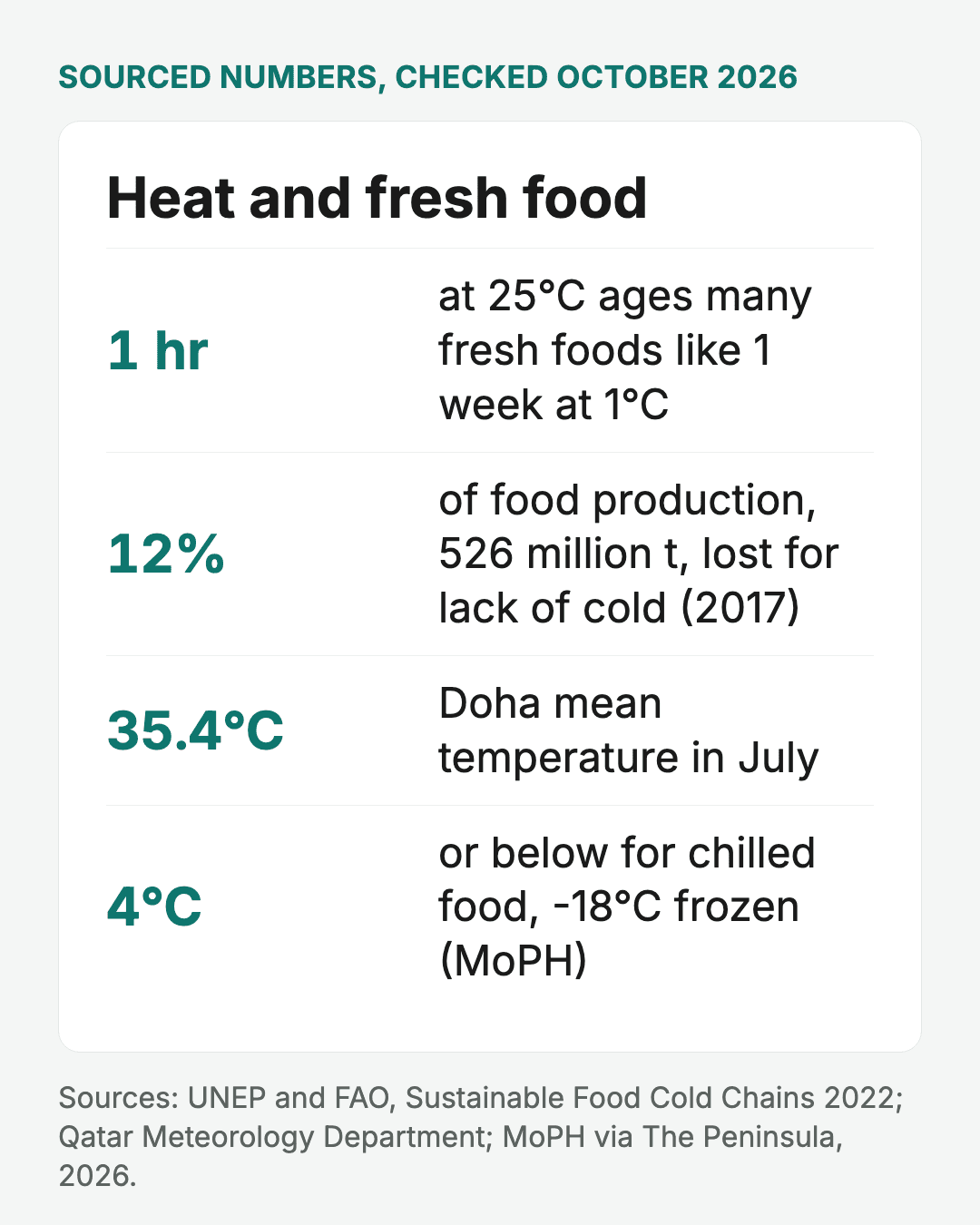
Heat and fresh food: one hour at 25°C ages many fresh products as much as a week at 1°C, and 12% of world food was lost for lack of refrigeration in 2017.
Why does food spoil faster in the heat?
Heat speeds up the life of fresh food. Fruit and vegetables keep breathing after harvest, and warm air makes them use up their water and sugars faster, so they wilt, soften and rot sooner.
One hour at 25°C, one week at 1°C
The 2022 UNEP and FAO report puts a number on it: many fresh products deteriorate at the same rate in one hour at 25°C as in one week at 1°C. A crate of herbs that waits 30 minutes on a warm loading bay has lost days of shelf life before anyone opens it.
What heat does to chilled meat, dairy and cooked food
For chicken, fish, dairy and cooked dishes, the risk is bacteria. Food left between fridge cold and cooking hot gives them time to grow. That is why Qatar's Ministry of Public Health tells people not to leave food out of the fridge for more than two hours (MoPH summer advice, reported by Marhaba, Aug 2026).
How much food is lost for lack of refrigeration?
The world lost 526 million tonnes of food in 2017 because it was not kept cold, 12% of all food produced, according to UNEP and FAO (2022). The report says that food could have fed about 1 billion people.
How much food got the cold it needed: less than half, 45%, of the food that needed refrigeration in 2017 was refrigerated (same report, citing the International Institute of Refrigeration).
What a better cold chain could save: the International Institute of Refrigeration estimates an improved cold chain would avoid 55% of the food losses linked to the current one (2021 note).
Loss and waste overall: the FAO estimates 13.3% of the world's food was lost between harvest and the shop in 2023 (FAO, SDG 12.3.1), and UNEP estimates 19% was wasted in shops, food service and homes in 2022 (UNEP, 2024).
Food that spoils in a truck or a warehouse counts as food loss; food that spoils in your walk-in counts as food waste. See the difference between food loss and food waste.
Does heat raise food waste?
UNEP found "a slight positive relationship" between a country's average temperature and its household food waste (Food Waste Index Report 2024), and its March 2024 release said hotter countries "appear" to waste more at home, possibly because of more fresh food and weaker cold chains. The finding covers homes, and no Gulf cold chain loss figure exists, so heat may be one cause, not a proven one. For Qatar's own numbers, read how much food Qatar wastes.
How hot is a Qatar summer for food?
Doha's mean air temperature, day and night together, is 34.6°C in June, 35.4°C in July, 34.9°C in August and 32.9°C in September, according to the Qatar Meteorology Department. The hottest temperature on record is 50.4°C, in July 2010.
August adds humidity: a mean of 58%, which the department describes as very hot and uncomfortable. For food, the hours of risk sit at three points:
The loading bay: the time between the van door and the walk-in.
The van itself: heat and humidity make transport fridges work harder and use more energy, according to a 2025 IIR and UNEP brief on refrigerated transport in hot climates, which names heavy insulation, correctly sized units and good maintenance as the fixes.
The kitchen door: a fridge or cold room opened often in a hot kitchen struggles to hold its temperature.
Doha's mean air temperature reaches 35.4°C in July, so fresh produce has hours, not days, outside the cold chain.
What temperatures does Qatar ask for?
Qatar's Ministry of Public Health advises keeping chilled food at 4°C or below and frozen food at -18°C (Ministry of Public Health, as reported by The Peninsula, Mar 2026).
Chilled: 4°C or below.
Frozen: -18°C.
Hot holding: 65°C or above (MoPH summer advice, reported by Marhaba, Aug 2026).
Time out of the fridge: no more than two hours (same advice).
In delivery vehicles: 0 to 4°C for chilled food, -18°C for frozen and at least 64°C for hot food (Ministry of Municipality, reported by The Peninsula, 2022).
A box can feel cold on the outside and sit warm in the middle. Use a probe thermometer and check your own food safety plan for the limits your kitchen follows.
How do you receive a chilled delivery in summer?
You receive a chilled delivery by checking the van, probing the food and moving it into cold storage before you do anything else.
1. Check the van and probe the food
Look at the van before the crates come off: is it a cold vehicle, and are the packs closed and dry? Probe a chilled item and a frozen one from each delivery, and write down the reading.
2. Cut the time from van to fridge
Move chilled and frozen goods first, counting them at the cold room door if you can. In summer, schedule deliveries for the early hours when the bay is quiet and a person is free to receive.
3. Refuse and record
If a chilled pack reads warm, refuse it at the door and write the reason while the driver is still there. Our goods receiving procedure walks through the seven steps.

Qatar's Ministry of Municipality asks delivery vehicles to carry chilled food at 0 to 4°C and frozen food at -18°C.
How do you store and rotate stock in the heat?
You store stock in the heat by using the oldest first, keeping cold air moving and checking the fridge temperature every day.
First in, first out, with a date on every pack
After the lunch rush, a cook moves yesterday's yoghurt to the front of the shelf and puts today's at the back, writing the date on the lid. Nobody watches her do it, and it is how food gets eaten instead of thrown away. That habit is first in, first out (FIFO): new stock goes behind old stock.

First in, first out keeps older stock in front, and Qatar's health ministry advises keeping chilled food at 4°C or below.
Do not overfill or prop the door
A packed fridge blocks the cold air, and a door propped open during a busy shift lets the heat in. Leave space between crates and close the door between trips.
Log fridge temperatures and count often
Read and write down each fridge's temperature at the start and end of every shift. Count fast-moving fresh items often, so you see what sits too long. See how to do a stock count.
Why order smaller and more often in summer?
Smaller, more frequent orders mean fewer days on the shelf for fresh food, and fewer days on the shelf mean fewer hours exposed to heat.
Order to a par level: decide how much of each fresh item you need until the next delivery, and order the gap.
Use your supplier's delivery days: two smaller drops a week often beat one large one for herbs, leaves and dairy.
Compare orders with use: last week's order against last week's use shows what you over-ordered. See why restaurants over-order.
Suppliers carry their part too: insulated, well maintained vans, and loads planned around a kitchen's real orders.
How Wady helps with food loss in the heat
Wady keeps the records behind receiving, stock and ordering, so less food sits too long in the heat. Over 100 businesses in Qatar already use Wady.
For us this is the reason Wady exists. Our mission is to cut food waste in the Gulf by digitizing the order between a kitchen and the suppliers it already buys from. Our vision is a Gulf food supply chain where every order is visible, so suppliers and kitchens see demand before it arrives, order what will be used, and throw less away. A grower picks in the cool before sunrise because the produce has hours, not days. When a kitchen orders what it will use this week, that early start pays off. Food grown for what people will eat, not for a guess. One tomato's story shows where it gets lost along the way.

In 2017, the food lost for lack of refrigeration could have fed about 1 billion people, according to UNEP and FAO.
What it does
Purchase System (free): all your suppliers in one app, every order saved with items, quantities and prices, and the delivery date picked from the supplier's real delivery days. See the Purchase System.
Receiving (Wady Central): receive by confirming, not typing. Rejected packs never go into stock, and a short delivery is closed with a reason. See purchasing and receiving.
Stock (Wady Central): low-stock alerts with the cost to refill, and a min and par level you set, so you order the gap.
Production (Wady Central): plan from real orders, minus what is in stock, so a central kitchen cooks what outlets ordered.
Waste (Wady Central): a shift's waste in one entry, with your reasons, for example "Lettuce, Wastage, -300 gm, Spoiled, left out overnight", and waste cost by period, reason and item. See counts and waste.
What it does not do
Wady does not measure or log temperatures, read fridge sensors, track trucks or forecast demand. The person at the door still checks the temperature with a probe; Wady records what they accept, reject and throw away.
Who it is for
Restaurants, cafes, hotels and catering kitchens in Qatar, from one cafe to a group with a central kitchen. Wady works in Qatar only for now.
Related articles
How much food does Qatar waste? The sourced numbers and where waste starts
Food loss vs food waste: what is the difference, and why it matters for the Gulf
Goods Receiving Procedure: How to Check and Record a Supplier Delivery
Keep summer deliveries cold
Message us on WhatsApp at +974 7000 7658 for a Wady Central walkthrough, or read more on Wady Central. The free Purchase System is at order.wady.ai, on the App Store and on Google Play. Qatar only for now.
Frequently asked questions
Your kitchen's stock, recipes and costing, with numbers from real records.


