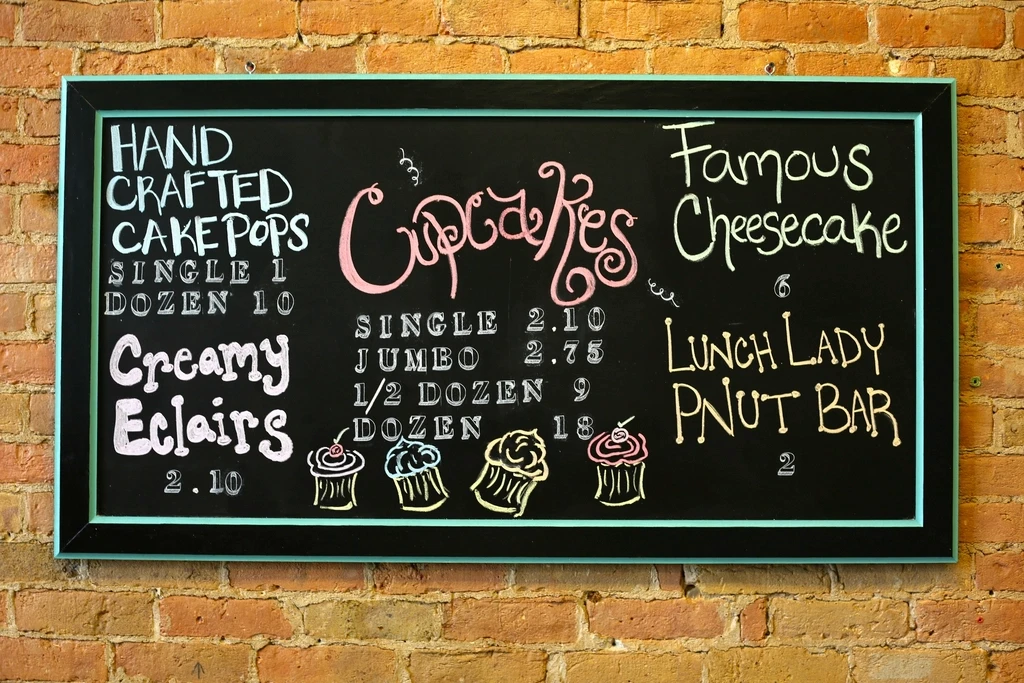
Restaurant marketing in Qatar: a practical guide for restaurants and cafes (2026)
By Asaad Al Hashmi, Founder and CEO of Wady

Restaurant marketing is how a restaurant or cafe in Qatar gets found, chosen and visited again by guests. Start with your guests and what each dish earns, not with a discount. This guide covers guest profiles, the 4 Ps, the math behind a discount, the channels that reach guests in Qatar, Qatar's promotion rules, a 12-month campaign calendar and how to measure results.
We are Wady. We don't sell marketing tools; we make purchasing and food cost software that restaurants can use to check what each offer costs.
Qatar's rules and platform facts were checked on 9 October 2026, with sources linked in each section. This guide is not legal advice.
Key takeaways
Start from a guest profile and what each dish earns, not a discount.
A discount cuts gross profit per dish by a bigger percentage than the price: 20% off a dish with a 30% food cost needs 40% more orders (example numbers).
A discount needs approval from the Ministry of Commerce and Industry (MOCI), prices must be in Arabic, and marketing messages need prior consent.
Pick two or three channels and compare them on cost per new guest.
Confirm stock and supplier delivery days before a campaign.
What is restaurant marketing?
Restaurant marketing is everything a restaurant does to be found, chosen and revisited by guests. A restaurant marketing strategy covers four parts, the 4 Ps: product, place, price and promotion.
Why plan before you run an offer?
A restaurant should plan before it runs an offer because every offer is a price decision. An offer changes what each dish earns, and in Qatar a discount needs approval from the Ministry of Commerce and Industry (MOCI) before you announce it.
Who are your guests? How to build guest profiles
A guest profile (also called a persona) is a short description of one group of your guests: when they visit, how often, what they spend, what they order, which language they read and how they found you. Build two or three from your POS, delivery app dashboards and floor staff.
Three example guest profiles:
Weekday office lunch (example): works nearby, comes at midday, wants a fast, fixed-price meal.
Weekend family dinner (example): four or more people, higher spend per table.
Late-night delivery order (example): orders through an app after closing.
Pick one as your target for the quarter: the most profitable, the most loyal or the easiest to reach.
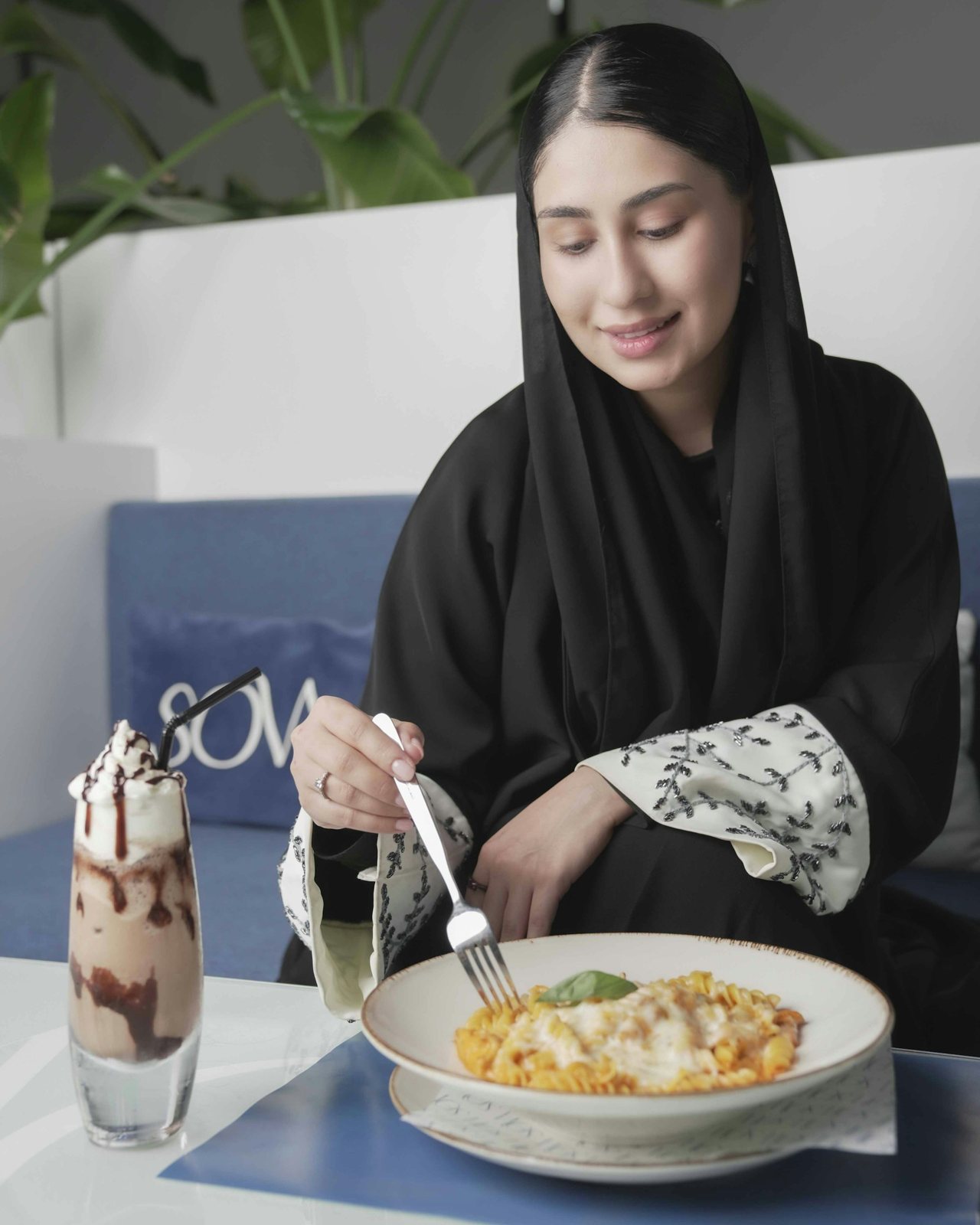
A guest profile describes one group of guests, such as guests who eat alone at a cafe table: when they visit, what they spend and what they order.
How do the 4 Ps of restaurant marketing apply in Qatar?
In Qatar, the 4 Ps mean a menu for your target guest profile, complete Google and delivery app listings, prices that earn money after discounts, and promotion in Arabic and English.
Product
Product is the menu and service you sell to your target guest profile. Put the dishes that guest orders most, and that earn the most gross profit per dish, first on your menu, in your photos and in your posts. Write each dish name in Arabic and English.
Place
Place is where guests find you: your location, Google Maps and the delivery apps. Keep your name, hours, phone number and menu the same on Google and on every delivery app, and update your hours for Ramadan and the Eids.
Price
Price is the menu price of each dish against what the dish costs you.
Food cost % is the ingredient cost of one dish as a share of its menu price.
Food cost % = food cost per dish ÷ menu price × 100
Gross profit per dish is the menu price left after the food cost of that dish.
Gross profit per dish = menu price - food cost per dish
To cost a dish, read How to calculate food cost and recipe cost. To set a menu price, read How do I price my menu items based on food cost?.
Promotion
Promotion is how guests hear about you and get a reason to visit. Choose the channel by guest profile:
Weekday office lunch: Google Maps, and location ads around nearby offices.
Weekend family dinner: Instagram or Snapchat posts before the weekend.
Late-night delivery order: your delivery app listing and a card in every bag.
How much more do you need to sell to pay for a discount?
A discount cuts gross profit per dish by a bigger percentage than it cuts the price, so you need more orders to earn the same gross profit. In the example numbers, 20% off a dish with a 30% food cost needs 40% more orders.
Gross profit per dish after the offer = discounted price - food cost per dish
Extra orders needed (%) = ((gross profit per dish before the offer ÷ gross profit per dish after the offer) - 1) × 100
Worked example: 20% off a QAR 48 dish
A dish sells for QAR 48 and costs QAR 14.40 in ingredients, a food cost of 30% (example numbers).
Gross profit per dish before the offer: 48 - 14.40 = QAR 33.60
Gross profit per dish after the offer: 38.40 (QAR 48 less 20%) - 14.40 = QAR 24.00
Extra orders needed: ((33.60 ÷ 24.00) - 1) × 100 = 40% more orders, or 1.4 times the current orders
In the example numbers, the price and gross profit per dish each fell QAR 9.60: 20% of the price, but about 29% of the gross profit, because the ingredients still cost QAR 14.40.

An owner checks the numbers on his phone before he decides whether a discount will pay for itself.
Worked example: 20% off a QAR 48 dish on a delivery app
Commission rates in Qatar are set in each restaurant's contract and are not public, so use your own rate. This example uses 20% on the QAR 38.40 price (example numbers, not market rates).
Commission (example rate, on the discounted price): 0.20 × 38.40 = QAR 7.68
Gross profit per dish after the offer and commission: 38.40 - 14.40 - 7.68 = QAR 16.32
Extra orders needed against a full-price sale with no commission (QAR 33.60): ((33.60 ÷ 16.32) - 1) × 100 = about 106% more orders, or about 2.06 times the current orders
If your full-price orders also come through the app, compare against a full-price app order after commission, not QAR 33.60: 48 - 14.40 - 9.60 = QAR 24.00, so the offer needs about 47% more orders (example numbers).
Restaurant promotion ideas that protect your margin
Add a low-cost item, such as a free side or drink, instead of cutting the price.
Bundle dishes with a high gross profit per dish with items guests already buy.
Target slow hours your POS shows.
Cap the offer by date, quantity or one per guest.
Checklist before you launch an offer
Check this month's food cost % of the dish.
Work out the new gross profit per dish, after commission on a delivery app.
Calculate the extra orders needed and whether the offer can win them.
Confirm stock and supplier delivery days for the campaign.
Get MOCI approval before you announce the discount.
Which marketing channels work for restaurants in Qatar?
Restaurants in Qatar reach guests through seven channels, and a restaurant should start with Google Business Profile, then add one social channel.
DataReportal's Digital 2026: Qatar (published November 2025, data from October 2025) shows how many people in Qatar are online and how many each platform's ads reach:
Internet users: 3.10 million (99.0% of the population)
Social media user identities: 2.95 million (94.3%)
Facebook ad reach: 2.40 million
YouTube ad reach: 2.31 million
Instagram ad reach: 1.70 million (54.3% of the population)
Snapchat ad reach: 1.24 million (39.5%)
TikTok ad reach: 2.95 million people aged 18 and above, which DataReportal says equals 114.1% of adults aged 18 and above, so treat it as an overcount
Ad reach is not the same as monthly active users.
Google Business Profile and Google Maps
Best for: guests searching nearby.
Cost: staff time.
Effort: low to medium.
What to measure: new guests from Google Maps, review count and rating.
Google says local results depend on relevance, distance and prominence, and that more reviews and positive ratings can help local ranking (Google Business Profile Help). Replying to reviews shows you value feedback.
Instagram, TikTok and Snapchat
Best for: guests who browse on phones.
Cost: staff time and any ad budget.
Effort: medium.
What to measure: new guests who name the platform, offer code uses.
Meta ads can target people who live in, recently spent time in or often go to a location, with a radius option (Meta).
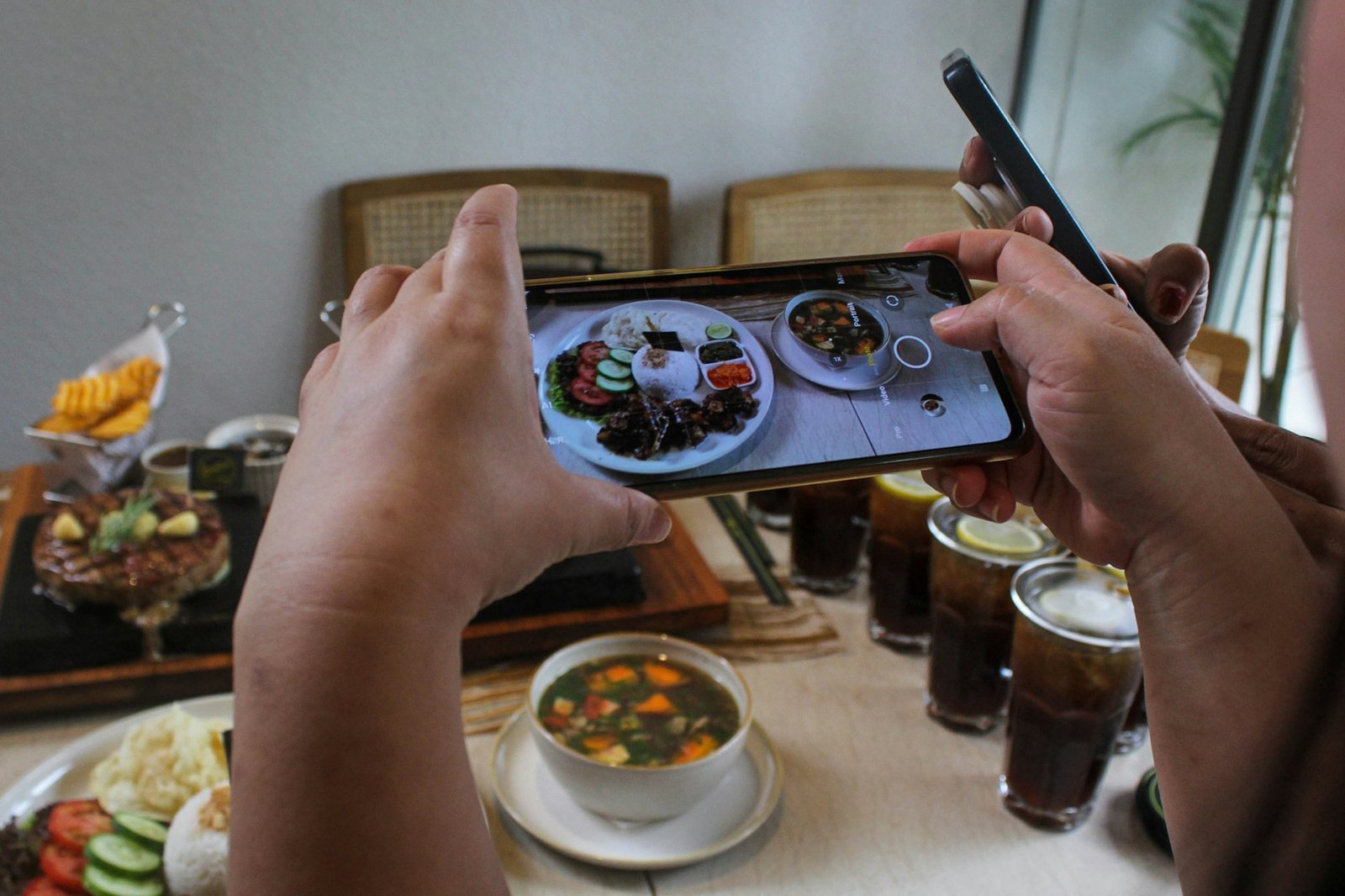
A guest who photographs a dish at the table and posts it shows your food to their own followers.
WhatsApp Business
Best for: regulars and catering enquiries.
Cost: staff time.
Effort: medium.
What to measure: opt-in list size, orders from WhatsApp, offer code uses.
The WhatsApp Business app offers a catalog, quick replies, labels, broadcasts, greeting and away messages and a business profile (WhatsApp Business). WhatsApp's business policy requires opt-in permission before you message a person (policy).
Delivery apps
Best for: guests who order through an app.
Cost: a commission on each order, at your contract rate.
Effort: medium: keep menu, prices and stock current.
What to measure: gross profit per order after discount and commission, repeat orders.
Delivery apps in Qatar:
Talabat: lists Qatar among its markets (Talabat).
Keeta: launched in August 2025 (Qatar Tribune).
Snoonu and Rafeeq: Qatari apps (Rafeeq on the App Store).
Deliveroo: last day was 4 March 2026 (Gulf News).

A delivery rider carries an order through the city at night, and on delivery app orders the restaurant pays a commission set in its own contract.
Reviews and reputation
Best for: guests who read reviews first.
Cost: staff time.
Effort: low per day.
What to measure: review count, average rating, share of reviews you replied to.
In BrightLocal's Local Consumer Review Survey 2026 (published February 2026, 1,002 US adults, not Qatar), 97% read reviews for local businesses and 47% would not use a business with fewer than 20 reviews (BrightLocal). Reply to every review in the language it was written in.
Loyalty for regulars
Best for: guests who could visit more often.
Cost: the reward's value, so use low food cost % items such as a drink.
Effort: medium: you may need a MOCI licence.
What to measure: repeat rate and gross profit per visit for members.
Check with MOCI on 16001 whether your programme needs a licence before you launch it.
Local and in-store
Best for: guests who live, work or pass nearby.
Cost: printing and staff time.
Effort: low to medium.
What to measure: redemptions of a printed offer code.
Put an offer card in every delivery bag. A printed discount needs MOCI approval.
What rules apply to restaurant promotions in Qatar?
Three rules apply to restaurant promotions in Qatar: approval from the Ministry of Commerce and Industry (MOCI) before you announce a discount, prices displayed in Arabic, and consent before marketing messages.
Discount approval (MOCI): MOCI's Department of Specialised Licensing and Markets must approve sales and promotional discounts before you announce them (Minister of Economy and Commerce Decision No. 311 of 2018 on sales at reduced prices). On 22 April 2026 MOCI fined an electronic delivery platform QAR 10,000 for advertising discounts without prior authorization (Qatar Tribune). Since February 2026 you can apply for, amend or cancel a special offer or loyalty programme licence through MOCI's digital platform (The Peninsula).
Prices in Arabic: MOCI requires businesses, including virtual platforms, social media sellers and home businesses, to display price lists clearly in Arabic, and other languages are allowed (Law No. 8 of 2008 on Consumer Protection, Articles 7, 8, 11 and 17) (Qatar Tribune). During discounts, guests have the right to see the price before and after the discount (MOCI, July 2026) (The Peninsula).
Consent before marketing messages: Qatar's Personal Data Privacy Protection Law (Law No. 13 of 2016), Article 22, forbids direct marketing by electronic communication without the person's prior consent. The message must identify the sender and give a way to opt out, and the 2020 regulator guidelines say consent must be explicit and easy to withdraw (Clyde & Co).
This is a summary, not legal advice. Check discount approval and price display rules, including any fee and processing time, with MOCI (call centre 16001, www.moci.gov.qa).
When should a restaurant in Qatar run campaigns?
A restaurant in Qatar should plan campaigns around National Day, Ramadan and the two Eids, plus its own slow days, from October 2026 to September 2027.
October 2026: set your baseline from POS sales and food cost %.
November 2026: cost the National Day offer and apply to MOCI.
December 2026: run your costed offer for Qatar National Day on 18 December.
January 2027: prepare for Ramadan: cost new menus, confirm supplier stock and holiday closures.
February 2027: Ramadan is expected to start about 8 February 2027, with the exact date set by moon sighting (Gulf News). Qatar National Sport Day, the second Tuesday of February, falls on 9 February 2027, in the expected first days of Ramadan.
March 2027: Eid al-Fitr is expected about 9 or 10 March 2027 (Khaleej Times).
April 2027: run one costed offer on your slowest days.
May 2027: Eid al-Adha is expected about 16 or 17 May 2027 (Khaleej Times).
June to September 2027: no national dates: run one costed offer a month on slow days.
How do you build a restaurant marketing plan?
Build a restaurant marketing plan in five steps, from one goal for the quarter to a weekly review.
Set one goal for the quarter. Example SMART goal: between 1 January and 31 March 2027, raise the share of weekday lunch guests who return within 30 days from 20% to 25% (example numbers).
Pick two or three channels that fit your target guest profile.
Set a test budget you can afford to lose.
Build a calendar from the campaign dates and your slow days.
Review every week with six measures: new guests, repeat rate, average order value, cost per new guest, gross profit per order after discount and commission, and food cost % after discount of the promoted dishes.
How do you measure restaurant marketing?
Measure restaurant marketing weekly with six numbers: new guests, repeat rate, average order value, cost per new guest, gross profit per order and food cost % after discount.
New guests = first-time guests in the period
Repeat rate = guests from the period who came back within 30 days of their first visit in it ÷ all guests from the period × 100 (count it 30 days after the period ends; example numbers: 20 of 100 guests = 20%)
Average order value = total sales ÷ number of orders
Cost per new guest = spend on a channel (ads, printing, rewards, discounts) ÷ new guests from that channel
Gross profit per order after discount and commission = order total after discount - food cost of the order - commission
Food cost % after discount (promoted dish) = food cost per dish ÷ price paid after discount × 100 (example numbers: 14.40 ÷ 38.40 × 100 = 37.5%, against 30% at the QAR 48 menu price)
To see which channel brought each guest, give each channel its own offer code and ask "how did you hear about us?" in Arabic and English.
Where should a small restaurant or cafe start?
A new or small restaurant or cafe with 3 hours a week should do these five things, in this order.
Complete your Google Business Profile in Arabic and English, with current hours, menu and photos.
Set a review routine: ask happy guests for a review and reply to each one.
Pick one social rhythm, such as two posts a week on one platform.
Set up a WhatsApp Business catalog and an opt-in list.
Run one costed offer a month. Before it goes live, check food cost %, gross profit per dish, extra orders needed, stock and supplier delivery days, and get MOCI approval. Then measure the result.
How Wady helps with restaurant marketing
Wady helps by giving you the cost and supplier facts to check each offer: Wady Central shows each dish's food cost % at its menu price, and the free Purchase System holds each supplier's delivery days and cut-off times. Wady does not run the marketing itself.
What it does
Real yield costing: Wady Central costs recipes on usable yield after trim, so trim loss is part of the recipe cost.
Food cost % at a menu price: in Wady Central, each recipe shows its food cost % at its menu price (guide: Food Cost and Margin for Each Dish in Wady Central).
Costs that move with suppliers: Wady Central re-costs a recipe the moment a price moves, and flags price rises and falls on delivery.
Reports and Daily Brief: Wady Central has menu and margin reports, a flag when a dish passes a target food cost, and a Daily Brief that shows which recipes moved cost and which ingredient caused it.
Supplier facts: the free Purchase System holds your suppliers with their delivery days, cut-off times and minimum order, and shows spend per branch and per supplier the day it happens.
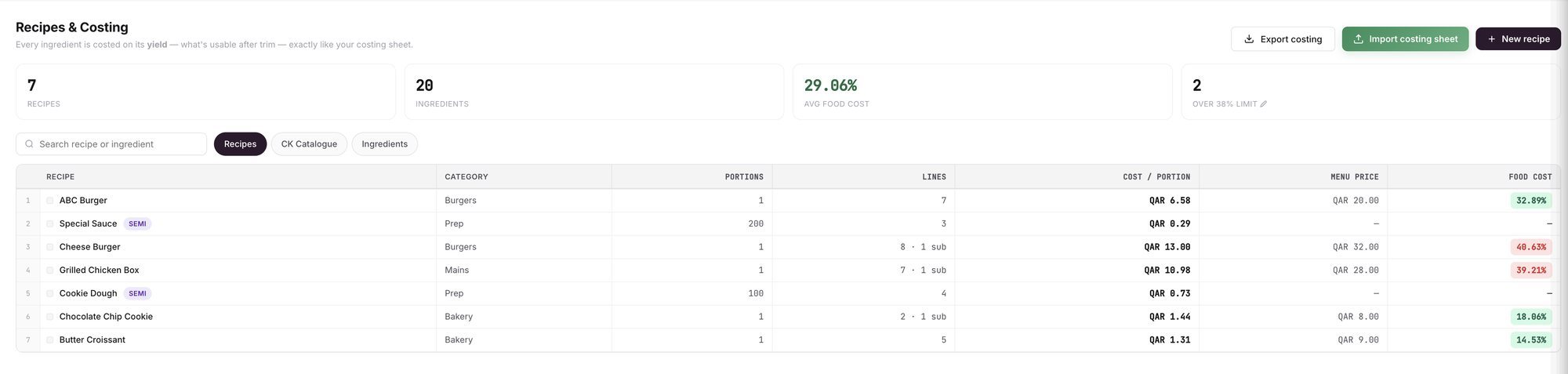
An example screen shows the Recipes and Costing page in Wady Central, with cost per portion, menu price and food cost for each recipe.
What it does not do
Wady does not run ads, social posts, loyalty programmes or delivery app listings. Wady Central has no POS API connection yet, so it works alongside your POS, and it is in English only today.
Who it is for
Purchase System: for restaurants, cafes, hotels and catering kitchens in Qatar, 100% free, with no fees and no contracts.
Wady Central: for any size of kitchen, from one cafe to a multi-branch group with a central kitchen (Wady Central).
Wady Central price: on the pricing page, with no VAT in Qatar (see pricing).
Who uses Wady: over 100 businesses in Qatar, including Crave Holdings and OMC.
Walkthrough: a Wady Central walkthrough on your own setup takes 20 minutes.
FAQ about restaurant marketing in Qatar
Do I need a permit to run a discount in Qatar?
Yes. The Ministry of Commerce and Industry (MOCI) must approve a discount before you announce it. Ask MOCI on 16001 whether a fee applies and how long approval takes. This is not legal advice.
Can I send WhatsApp offers to my customers?
Yes, to people who opted in first, as WhatsApp's business policy and Qatar's Personal Data Privacy Protection Law (Law No. 13 of 2016), Article 22, require. Offer an opt-out and get MOCI approval for any discount in the message. This is not legal advice.
Should restaurant marketing in Qatar be in Arabic or English?
Use both. MOCI requires price lists in Arabic and allows other languages, so write menus, posts and Google listings in Arabic and English, and reply to each guest in the language they wrote in.
Which social media platform reaches the most people in Qatar?
TikTok has the largest ad reach on DataReportal's late 2025 figures, 2.95 million people aged 18 and above, but DataReportal says that equals 114.1% of adults, so treat it as an overcount. Facebook, YouTube, Instagram and Snapchat follow (DataReportal).
How much should a restaurant in Qatar spend on marketing?
No fixed rule fits every restaurant. Test one or two channels with a small budget and compare cost per new guest with the gross profit that guest brings in a set window, such as their first 30 days (gross profit per order after discount and commission, added up).
Related articles
Price your next offer on real costs
Work out what an offer costs before you announce it. The free Purchase System shows the prices you actually paid your suppliers (order.wady.ai, App Store, Google Play), and Wady Central shows each recipe's food cost % at its menu price. For a walkthrough, message us on WhatsApp at +974 7000 7658.
Your kitchen's stock, recipes and costing, with numbers from real records.