10 restaurant menu ideas for Qatar, and what each one does to your food cost
By Asaad Al Hashmi, Founder and CEO of Wady

A good restaurant menu sells the dishes that earn the most and asks the kitchen only for what it can buy, cook and cost each time. This guide gives 10 menu ideas for restaurants and cafes in Qatar, with what each one asks of your recipes, stock and supplier orders and what it does to food cost.
Key takeaways
Your menu sells for you and sets your shopping list: each dish you add adds items to buy, count and cost.
Know your top earners from recipe cost and sales, then put them where guests look first.
A promise on the menu is a promise on the purchase order: name an ingredient only when your supplier delivers it each time.
Wady Central costs your recipes, keeps the allergens of each one and flags the recipes that moved cost.
What makes a restaurant menu work?
A restaurant menu is the list of what you sell, how it is grouped, described and priced. It shapes what guests order, and what guests order decides what you must buy.
A menu works when guests find the dishes you want to sell, each dish earns a margin you planned and the kitchen can make each dish from stock it can order. Design covers the first. This guide covers the other two: cost and ordering.

A guest reads the menu before ordering, and the dishes he sees first are the ones he is most likely to order.
What are good restaurant menu ideas for Qatar?
Good menu ideas for Qatar put top earners first, share ingredients across dishes, stay short, promise only what suppliers deliver and use Arabic and English. They also plan Ramadan sets, price catering per head, match photos to plates, use stock in specials and show portions and allergens.

An example menu made up for this article, where each numbered note matches one of the 10 ideas below. The dishes and prices are not real data.
1. Put the dishes that earn you the most where eyes land first
Put your highest earners at the top of each section and on the first screen of your delivery app listing.
Why it sells: The dish a guest sees first is the one most likely ordered.
What it asks of your kitchen and orders: You must know which dishes earn the most, from recipe cost. A top dish sells more, so you buy and stock more of its ingredients.
How to do it:
Cost every dish on usable yield and rank dishes by what each plate earns after food cost.
Place the top three or four first in each section.

An example delivery app listing made up for this article: the top earner sits first with the only photo, the set uses stock you carry, and each line shows its portion size.
2. Build combos and sets from ingredients you already stock
Build combos and sets from ingredients already on your shelves.
Why it sells: A set gives the guest a clear choice at a clear price and lifts the order value.
What it asks of your kitchen and orders: Fewer items to buy, count and waste. Each new ingredient adds a line to your purchase order and stock count.
How to do it:
Mark the ingredients that appear in three or more dishes and build the set around them.
Cost the set as one recipe, sub-recipes included.
3. Keep the menu short enough to sell everything before it spoils
Keep the menu short enough that you sell each fresh ingredient before it spoils.
Why it sells: A short menu reads faster, cooks faster and holds the same standard each time.
What it asks of your kitchen and orders: Every new dish adds items to buy, suppliers to manage, shelf space and count time.
How to do it:
Check slow dishes against the ingredients only they use, then cut or merge them.
Add a new dish only when another leaves.

In this example, chicken and rice cover three dishes with one order line each, while saffron adds a whole extra item for one slow dish.
4. Name the ingredient only when your supplier delivers it each time
Name the cut, the cheese or the origin only when your supplier delivers that exact item on each order.
Why it sells: A specific description makes a dish sound worth its price.
What it asks of your kitchen and orders: If the delivery brings another cut, you swap it or pull the dish, and both cost you. The recipe card and the purchase order must name it too.
How to do it:
Check each named ingredient against your supplier's catalogue and delivery days.
Keep the description general when the supply changes often.
5. Write the menu in Arabic and English, both written well
Print your menu in Arabic and English, each checked by a native reader. Commercial outlets in Qatar must display prices in Arabic, according to Qatar Tribune. Check the current rule with MOCI before you print.
Why it sells: Your guests read both languages, and a menu written well in each shows care.
What it asks of your kitchen and orders: Dish names must match across both languages, your delivery apps and your recipe cards.
How to do it:
Keep one master list of dish names in both languages and copy from it for every print and app.
Reprint both languages together when a price or dish changes.
6. Plan seasonal and Ramadan set menus with your supplier delivery days
Plan iftar and suhoor sets, and winter or summer dishes, around supplier delivery days and quantities.
Why it sells: A set gives guests a reason to visit in a season.
What it asks of your kitchen and orders: You need each set's quantity, each supplier's lead time and each order cut-off.
How to do it:
Work backwards from the first service date: order cut-off, delivery day, prep day.
Cost each set from its recipes and check the food cost % before you print the price.

An example plan for the first iftar service, counted back through prep, delivery and the supplier's order cut-off. The days, quantities and price are examples.
7. Offer catering trays and party boxes priced per head from recipe cost
Price catering trays and party boxes per head from recipe cost, with the yield worked out before you quote.
Why it sells: Catering brings a large order from one buyer, and a per-head price is simple to approve.
What it asks of your kitchen and orders: You need the portions per tray and the usable yield of each ingredient. Confirm quantities and delivery days with suppliers before you accept the booking.
How to do it:
Cost one portion on usable yield, multiply by the number of heads and add packaging.
Write the portion size on the quote.
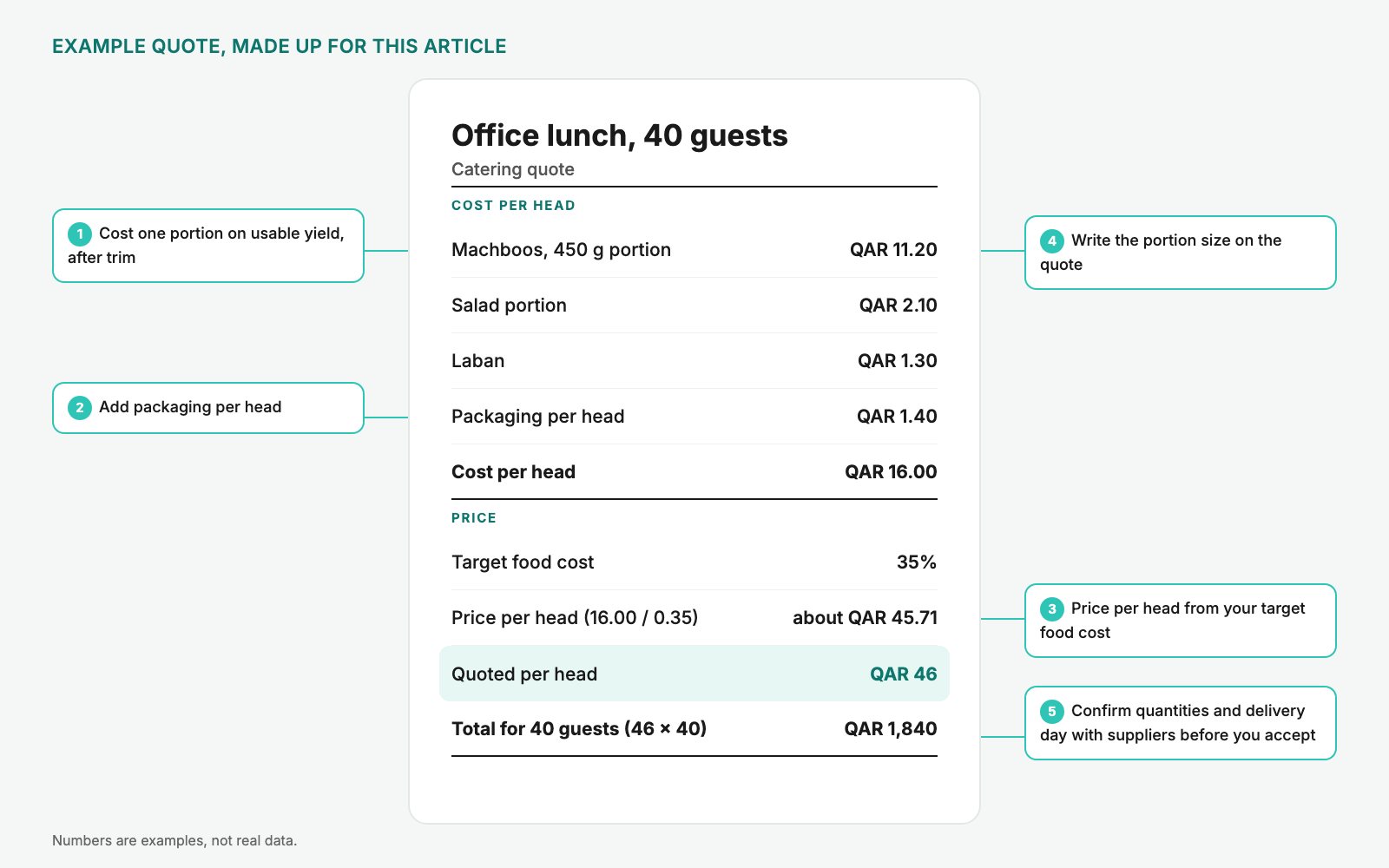
An example catering quote: cost one portion on usable yield, add packaging, then price per head from your target food cost. The numbers are examples.
8. Use photos for the dishes you most want to sell, and make the plate match
Use photos for the dishes you most want to sell, and make each plate match its photo.
Why it sells: Guests order what they can see.
What it asks of your kitchen and orders: A matching plate needs a fixed recipe and a fixed portion. If cooks add extra by eye, the plate costs more than your sheet says.
How to do it:
Photograph the plate from the written recipe, with the weighed portion.
Compare what the cook used with the recipe.

A chef plates a dish to a fixed recipe, so each plate matches its menu photo and costs what the recipe says.
9. Run daily or limited specials that use stock before it expires
Run daily or limited specials built from stock you already hold, so the special cuts waste and adds no new items to buy.
Why it sells: A special gives regulars something new and gives you something to post about.
What it asks of your kitchen and orders: You need to see what is close to expiry before you pick the special. A special that needs an ingredient you do not stock is a new purchase.
How to do it:
Check your stock list each morning and pick the items that need using first.
Cost the special from its recipe and limit the quantity to your stock.
10. Show portion size and allergens
Show the portion size and the allergens of each dish on the menu or on a card guests can ask for. Both come from the recipe card.
Why it sells: Guests trust a menu that tells them what they will eat.
What it asks of your kitchen and orders: You need recipe cards with exact ingredients and weights, which also give you cost per portion. When a supplier changes a product, the card and the menu line change with it.
How to do it:
Write a recipe card for each dish with every ingredient, its weight and the portion it makes.
List allergens from the card and review them when a supplier product changes. Wady Central keeps the allergens on each recipe, so you update them in one place.
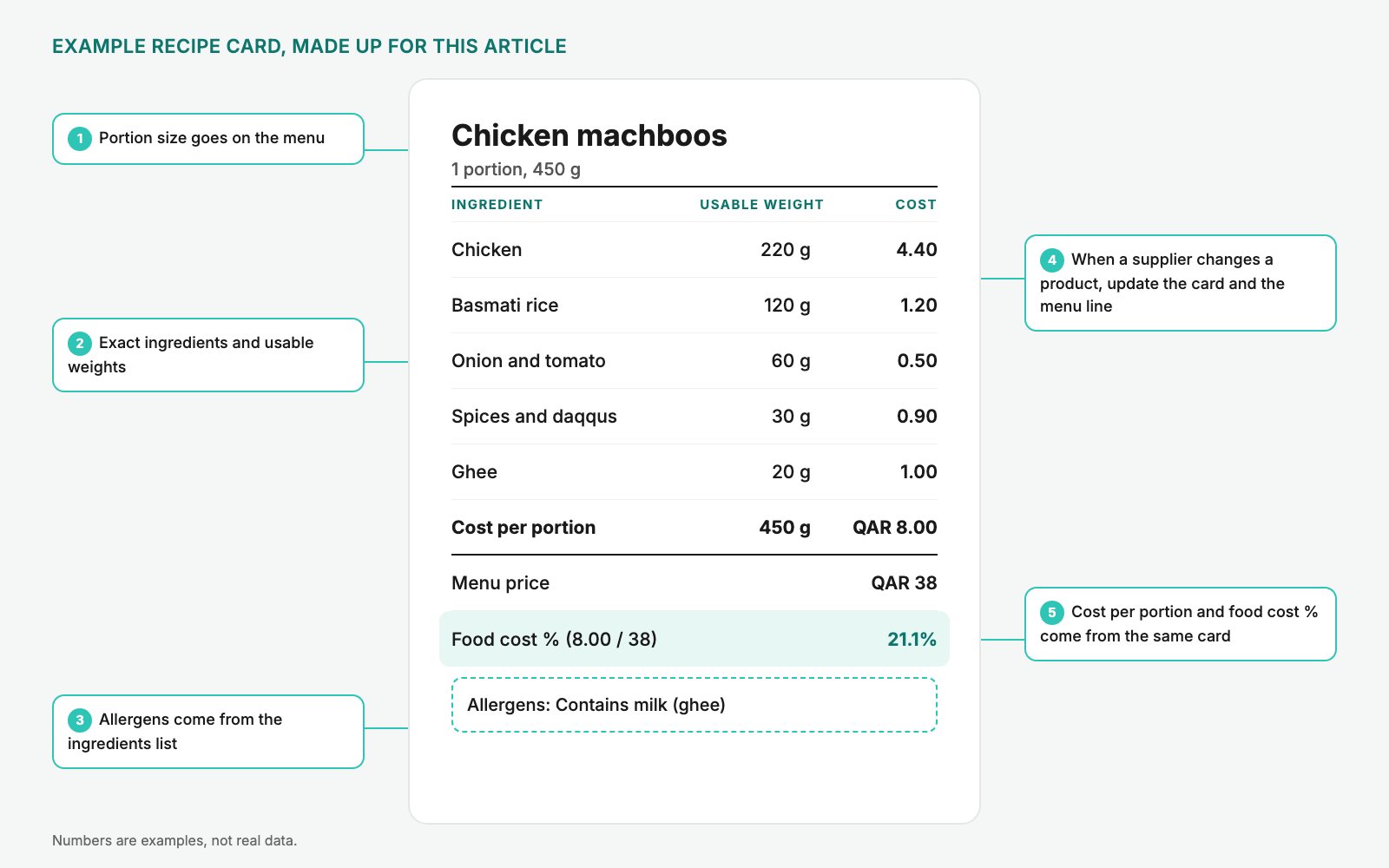
An example recipe card: one card gives the exact ingredients, portion size, allergens, cost per portion and food cost %.
How do you know which dishes earn their place?
Sort your dishes on two numbers: how many you sell and how much each plate earns after food cost. This is menu engineering. The four common groups are stars, plowhorses, puzzles and dogs, common industry labels and not Wady terms.
Example only. Invented numbers. A cafe sells four dishes in a month.
Grilled chicken plate: price QAR 45, food cost QAR 14, earns QAR 31 a plate, 400 sold, food cost 31%.
Beef burger: price QAR 38, food cost QAR 17, earns QAR 21 a plate, 420 sold, food cost 45%.
Lamb ouzi: price QAR 85, food cost QAR 30, earns QAR 55 a plate, 60 sold, food cost 35%.
Fish and chips: price QAR 42, food cost QAR 22, earns QAR 20 a plate, 50 sold, food cost 52%.
Together they sold 930 plates and earned QAR 25,520 after food cost, an average of QAR 27.44 a plate and 232 plates per dish. Compare each dish with both averages.
Chicken plate, star: sells and earns above average. Put it first and keep it stocked.
Burger, plowhorse: sells above average and earns below it. Check its recipe cost, portion and supplier price.
Lamb ouzi, puzzle: earns above average and sells below it. Give it a better place and description.
Fish and chips, dog: sells and earns below average. Cut it, unless other dishes need its ingredients.

The example dishes on a menu engineering chart: the chicken plate is a star, the burger a plowhorse, the lamb ouzi a puzzle and the fish and chips a dog.
A supplier price rise can turn a star into a plowhorse with no change on the menu. To set each price from its cost, read how to price your menu items from food cost.
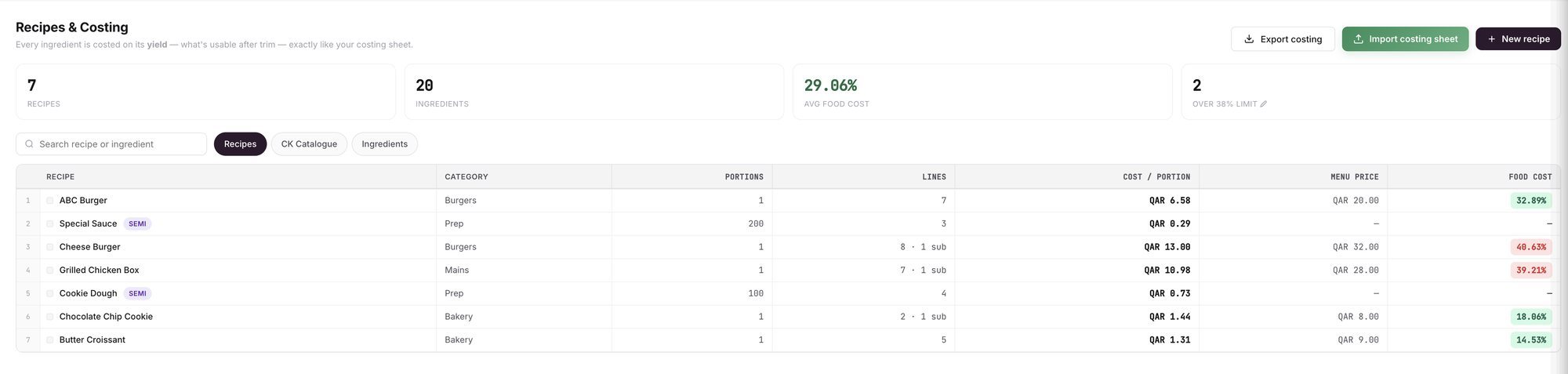
An example screen: the Recipes and Costing page in Wady Central shows the cost per portion, menu price and food cost % of each recipe.
What should you check before you print or update your menu?
Check cost, stock, supplier and language before every print, because a problem on the menu stays until the next print run.
Recipe cost: every dish has a current cost per portion on usable yield.
Food cost %: every dish sits at or near your target at its menu price.
Named ingredients: each one is on your supplier's current delivery list.
Stock and delivery days: you can hold enough ingredients between deliveries.
Languages: Arabic and English match, and prices show in Arabic (check the current rule with MOCI).
Portions and allergens: each dish has a recipe card that shows both.
How Wady helps with your menu
Wady works on the cost and ordering side behind your menu: Wady Central for recipe costing and purchasing, and the free Wady Purchase System for ordering from suppliers.
What it does
Recipes and costing: Wady Central shows recipe cost, cost per portion and food cost %, costed on usable yield after trim.
Costs that stay current: it re-costs a recipe when a price moves, and the Daily Brief shows which recipes moved and which ingredient caused it.
Allergens: Wady Central keeps the allergens of each recipe, so the recipe card and the menu line match.
Menu and margin reports: Wady Central has menu and margin reports and flags a dish that passes a target food cost.
Purchasing and par levels: you order every supplier from one place, set minimum and par levels, and get a purchase list built from your production plan.
Supplier days: the free Purchase System holds delivery days and cut-off times, so you plan sets against real days.

An example screen: Wady Central builds a purchase list from the production plan, so the dishes you plan to make become the ingredients you need to buy.
What it does not do
Wady Central has no POS integration yet, so it works alongside your POS, and it is in English only today.
Who it is for
Purchase System: restaurants, cafes, hotels and catering kitchens in Qatar, 100% free, no fees, no contracts.
Wady Central: any size of kitchen, from one cafe to a multi-branch group (Wady Central).
Wady Central price: on the pricing page, no VAT in Qatar (see pricing).
Who uses Wady: over 100 businesses in Qatar, including Crave Holdings and OMC.
Related articles
See what your recipes cost
See what each dish on your menu costs with Wady Central, and order from your suppliers free with the Wady Purchase System (order.wady.ai, App Store, Google Play). For a walkthrough, message us on WhatsApp at +974 7000 7658.
Frequently asked questions
Your kitchen's stock, recipes and costing, with numbers from real records.