What is Wady? The meaning of wadi, and why we named our company after it
By Asaad Al Hashmi, Founder and CEO of Wady

A wadi (Arabic وادي, also spelled wady) is a valley or riverbed in a desert that stays dry most of the year and fills with water when heavy rain comes. Wady is also the name of a company in Qatar that connects restaurants, cafes, hotels and catering kitchens with the food suppliers they buy from.
This article covers both: what the word means, and why we took it as our name. It ends with what Wady does today and where we want to take the Gulf's food supply chain.
Key takeaways
A wadi is a desert valley or riverbed that is dry most of the year and runs with water after heavy rain. "Wady" is an older English spelling of the same word.
Wadis held water under the ground, so people settled and met near them. In Arabia, trade gathered in the same places.
We named Wady after the wadi where buyers and sellers met. Wady does the same job online, for the food trade in Qatar.
Our mission is to cut food waste by making every order between a kitchen and its supplier visible.
What does wadi mean?
A wadi is a river valley or riverbed in a dry region that carries water only after heavy rain. Merriam-Webster defines it as "the bed or valley of a stream" that is "usually dry except during the rainy season." The word comes from the Arabic وادي (wādī), and English has used it since at least 1828.
You say it "WAH-dee". The plural is wadis.

Wadi Bih in Ras Al Khaimah: a dry gravel bed for most of the year, and a river when the rain comes. Photo: IbrahimKumar, CC0, Wikimedia Commons.
Wadi or wady: which spelling is right?
Both. Wadi is the common spelling today. Wiktionary lists wady as an archaic spelling of wadi, with the plurals wadies or wadys. We chose Wady with a y for our company name. In Arabic, both are the same word: وادي.
Where do you find wadis?
Across the Arabian Peninsula and North Africa. Oman has Wadi Bani Khalid, which holds water all year. The UAE has Wadi Shawkah and Wadi Ham. Yemen has Wadi Dawan. In Doha, the old market grew up beside Wadi Musheireb.
The word also travelled far from the desert. Spain's Guadalquivir river takes its name from the Arabic al-wādī al-kabīr, "the great river."
Why did people meet and trade at the wadi?
Water. People settled near wadis because water could often be found under the ground there, even when the bed looked dry (Wikipedia). Where there is water, there are wells, grazing and shade. Where people gather, trade follows.
Souq Okaz, the famous one
The best known example is Souq Okaz, which many people call Wadi Okaz (وادي عكاظ). Each year from the first to the twentieth of Dhu al-Qa'dah, tribes met there, between Wadi Nakhla and the city of Taif, to trade goods and recite poetry (Arabic Wikipedia). No yearly fair in Arabia before Islam was bigger or better known.
Souq Waqif in Doha
Qatar has its own version. Souq Waqif, the old market in the heart of Doha, is more than a hundred years old and grew up beside the dry riverbed of Wadi Musheireb. Bedouins and townspeople met there to buy and sell, mostly livestock and what came from it. Qatar restored the souq from 2006, after a fire in 2003, and it still trades today.
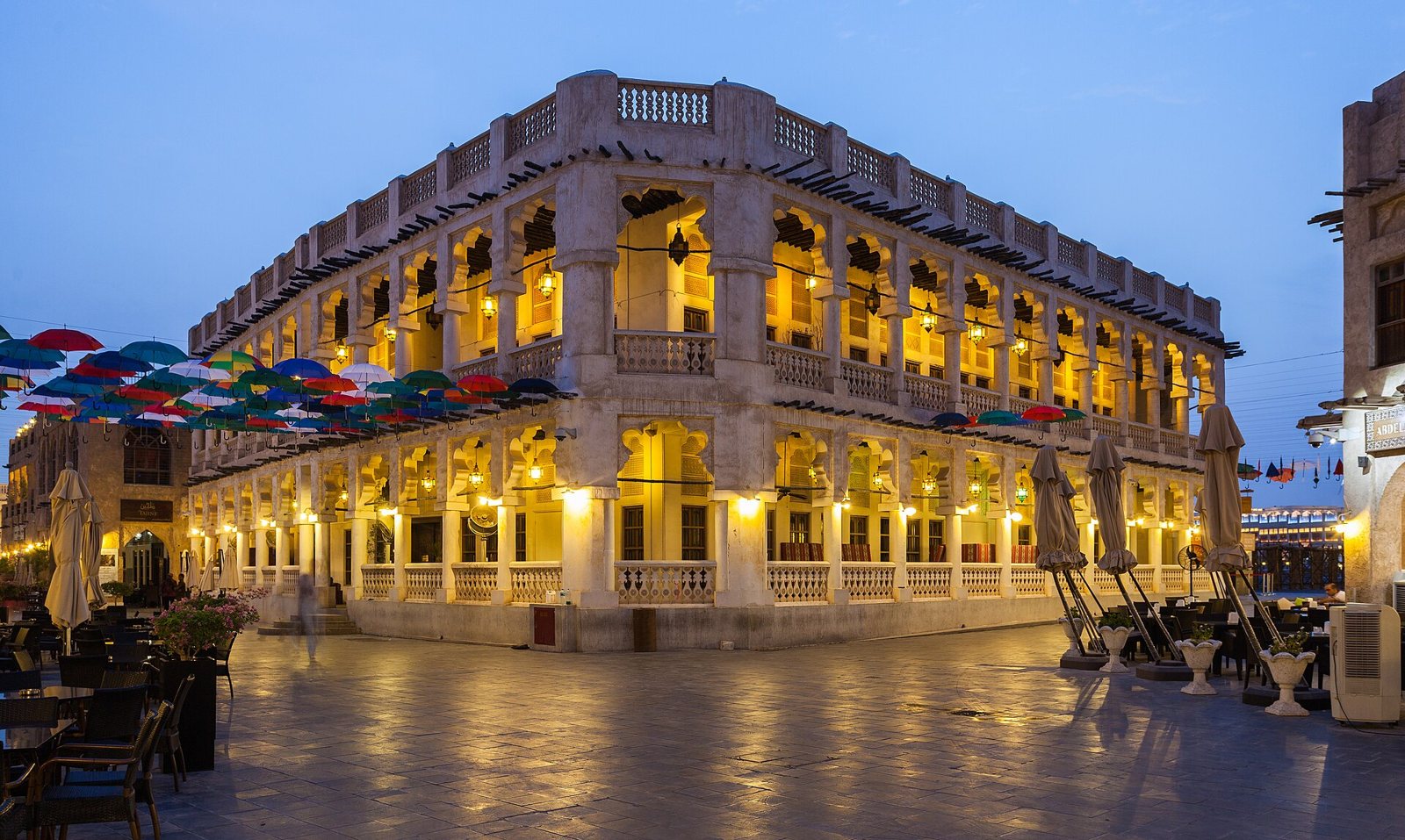
Souq Waqif grew up beside Wadi Musheireb in Doha. Photo: Diego Delso, CC BY-SA 3.0, Wikimedia Commons.
Why is our company called Wady?
Because the wadi was the old meeting place of the trade, and that is the job we took on.
Our founder, Asaad Al Hashmi, tells it like this:
"In the old days, if you had something to sell, you went to the wadi. People gathered there, brought their goods and started trading, and the buyers came to them. Wady is the same thing, in a modern way, in 2026."
Asaad Al Hashmi, Founder and CEO of Wady
Picture it. A seller walks into the valley with what he has. Buyers come down from their camps. Everyone knows where to go, and when. Prices get agreed face to face, and people come back next season to the same faces.
Now picture a restaurant kitchen in Doha at 6 in the morning. The chef sends the meat order as a voice note. The vegetables go to a WhatsApp group. The dairy supplier wants a phone call, and one supplier still wants an email. The trade is the same as it was in the valley: a buyer, a seller, a deal they both know. The meeting place has gone. It is scattered across a dozen chats on one phone.
Wady is the valley again, built for 2026. One place where a kitchen and its suppliers meet, see the same order, and keep a record of it.
What Wady is not
A wadi in the old days was open to anyone who walked in. Wady keeps the trust and the relationships, and stays private. It is not a marketplace. Your supplier list starts empty, and you see only the suppliers who gave you their code. Wady takes no commission and does not deliver the order or take the payment. Nothing about your deals changes. We digitize the relationships you already have.
What does Wady do today?
Wady runs three products for the food trade in Qatar:
The Purchase System, for buyers. Restaurants, cafes, hotels and catering kitchens order from all their suppliers in one app, with their agreed prices already loaded. It is 100% free for restaurants: no fees, no contracts, forever. Wady charges the suppliers, never the buyer. See the Purchase System.
The Order Management System, for suppliers. Suppliers receive orders, run their customers and catalogue, and see what each customer buys. See the supplier side.
Wady Central, for kitchens that need control. Stock, recipes, purchasing and costing in one system, from one cafe up to a group with a central kitchen. See Wady Central.

The valley, on a phone: every supplier a kitchen orders from, in one list.
Over 100 businesses in Qatar already use Wady, including Crave Holdings and OMC. Wady is built in Qatar, at Qatar Science & Technology Park, Qatar Foundation. Read more about Wady.
What are Wady's mission and vision?
Our mission: cut food waste in the Gulf by digitizing the order between a kitchen and the suppliers it already buys from.
Our vision: a Gulf food supply chain where every order is visible, so suppliers and kitchens can see demand before it arrives, order what will be used, and throw less away.
One line guides the whole company: digitization makes the supply chain visible, and forecasting makes it intelligent. You cannot prevent waste you cannot predict, and you cannot predict what you cannot see.
Why food waste?
Because the numbers are too big to ignore:
Roughly one third of the world's food is lost or wasted between the farm and the plate (UNEP Food Waste Index 2024).
People in the GCC waste about 150 kg of food per person a year, 14% above the global average of 132 kg (Oliver Wyman 2025, citing UNEP).
In Qatar, 25% of the food prepared during Ramadan goes to waste (UNEP Food Waste Index 2024, citing a 2022 Doha study).
Much of that waste starts at the order desk. Oliver Wyman found that in GCC retail, forecasting and restocking are often done by hand, on employee judgment, more for how the shelf looks than for real demand. A kitchen that orders from memory over WhatsApp orders too much to be safe. A supplier who cannot see what is coming stocks too much to be safe. Both throw the difference away.

Every order a kitchen places on Wady is a clear signal of what it will use.
Where we are going
We start where the waste starts: the order. Each order placed on Wady is recorded with its items, quantities and prices, so the trade stops being invisible. Today that gives kitchens and suppliers a clean record and less admin. Over time, those records are what let a supplier and a kitchen see demand coming, so both order closer to what they will sell.
We start in Qatar. The old wadis never stopped at a border, and neither does the Gulf's food trade, so our long-term vision is the wider GCC.
FAQ about Wady and the word wadi
What does wadi mean in English?
A wadi is a valley or riverbed in a desert region that is dry most of the year and fills with water after heavy rain. The word comes from Arabic وادي.
Is it spelled wadi or wady?
Both spellings mean the same thing. Wadi is the common modern spelling. Wady is an older spelling, and it is the name of our company.
What is Wady the company?
Wady is a company in Qatar that connects restaurants, cafes, hotels and catering kitchens with their food suppliers. Buyers order from all their suppliers in one free app, suppliers manage their orders and customers, and Wady Central adds stock, recipes and costing.
Who founded Wady?
Asaad Al Hashmi, Founder and CEO.
Is Wady a marketplace?
No. You see only the suppliers who gave you their code, Wady takes no commission, and your deals and prices stay between you and your supplier.
Where is Wady based?
In Qatar, at Qatar Science & Technology Park, Qatar Foundation.
Related articles
Come to the valley
If you run a restaurant, cafe, hotel or catering kitchen in Qatar, bring your suppliers to Wady. Download the app on the App Store or Google Play, or open order.wady.ai in your browser. It is free, and setup takes about five minutes. Suppliers and groups: message us on WhatsApp at +974 7000 7658.
All your orders from your suppliers in one place, free forever.


