
An order management system for food suppliers is software where a supplier's customers place their orders, and the supplier receives, checks and tracks every one in one place. It holds each customer's own prices and catalogue, their credit and payment terms, and the record of every order, so orders stop arriving on WhatsApp, email and phone. Wady's Order Management System does this for food suppliers and distributors in Qatar. This guide covers how orders arrive today, what the system does, and how prices, credit and reps work.
Key takeaways
An order management system is software where your customers place orders and you receive, check and track every one in one place.
It holds each customer's own price, catalogue, credit and payment terms, so orders stop arriving on WhatsApp, email and phone.
Each rep sees only their own customers, and prices stay with the admin.
In Wady's Order Management System the supplier pays and the customer orders free.
How do food distributors in Qatar receive orders today?
Suppliers in Qatar describe the same thing: orders arrive on three channels, WhatsApp groups, emails and phone calls, and they eat the team's day. These are things suppliers told us, not a measured study. WhatsApp's own page for the WhatsApp Business app describes it as a way to talk to customers one-on-one, show products and answer messages while away. The Ministry of Public Health's electronic food safety system, Watheq, registers food establishments, products and shipments. For a side-by-side look, read WhatsApp vs Wady for ordering.
Hours of admin. Salesmen come back from the market and spend two to four hours on admin. One order can take 30 to 40 minutes.
Order errors. A wrong price on the purchase order, a wrong quantity, cartons instead of pieces, an item suddenly out of stock.
Price worries. "Will competitors see our prices?" is the number one fear about any ordering platform.
Credit risk. Month-end blocks, 60 days becoming 90, buyers moving to the next supplier's credit.
A catalogue nobody sees. One supplier: "I have 1,000 SKUs, they know 6."
What does an order management system do?
Five jobs.

Receives every order in one place, structured, instead of on three channels.
Holds each customer's own price on the same product.
Controls who sees what in your catalogue.
Tracks credit and payment terms for each customer.
Gives each rep their own customers, with prices kept by the admin.
How do customer-specific prices and private catalogues work?
In Wady's Order Management System you set a different price per customer on the same product. You then choose what each customer sees: your catalogue with price, without price, private items only, or blocked. Each customer sees only their own price, with their own minimum order, by quantity or by value.
A customer connects with your code or invite link, and the code expires after three days. You can upload all your products and prices at once from a CSV file saved from Excel. More on prices and catalogue.
How do credit and payment work?
You see live credit for every customer, per branch. The customer sees it too before ordering, when they are on Wady. Alerts fire at 80%, 90% and 100% of the limit.
You set each customer's payment method: cash on delivery, credit, or a prepaid balance you track per customer. You can block an account whenever you need to, and bring it back. More on credit and payment.
What about sales reps?
Your team gets an admin account and a separate account for each rep. Each rep sees only their own customers, and reps cannot change prices, which stay with the admin.
WhatsApp vs spreadsheet or ERP export vs an order management system
WhatsApp, email and phone | Spreadsheet or ERP export | Order management system | |
|---|---|---|---|
Where orders arrive | Three channels, typed in by your team | Wherever they arrive, then entered by your team | One place, placed by the customer |
Customer prices | In a price list or the rep's memory | Held per customer in your own records | One price per customer, shown only to that customer |
Who sees your catalogue | Whatever you send in a chat | Internal, customers do not browse it | Per customer: with price, without, private only or blocked |
Credit | Checked by hand | Tracked in your accounts | Per customer and branch, with alerts |
Record of the order | Scattered across chats | Clean once entered | Saved with the order, purchase order generated |
Best at | Quick, familiar, free | Invoicing, stock, accounting | Receiving and controlling orders from many customers |
WhatsApp is hard to beat for speed and familiarity. A spreadsheet or ERP export is strong for your own records and invoicing. An order management system is built for the step before both: the customer placing the order. Integration questions are in supplier order management integrations. See end-to-end order fulfillment for food suppliers.
How Wady helps with order management for food suppliers
How does Wady's Order Management System work?
Wady's Order Management System is the paid system for food suppliers and distributors in Qatar. The supplier pays. The customer orders free, in the Wady B2B app or at order.wady.ai.
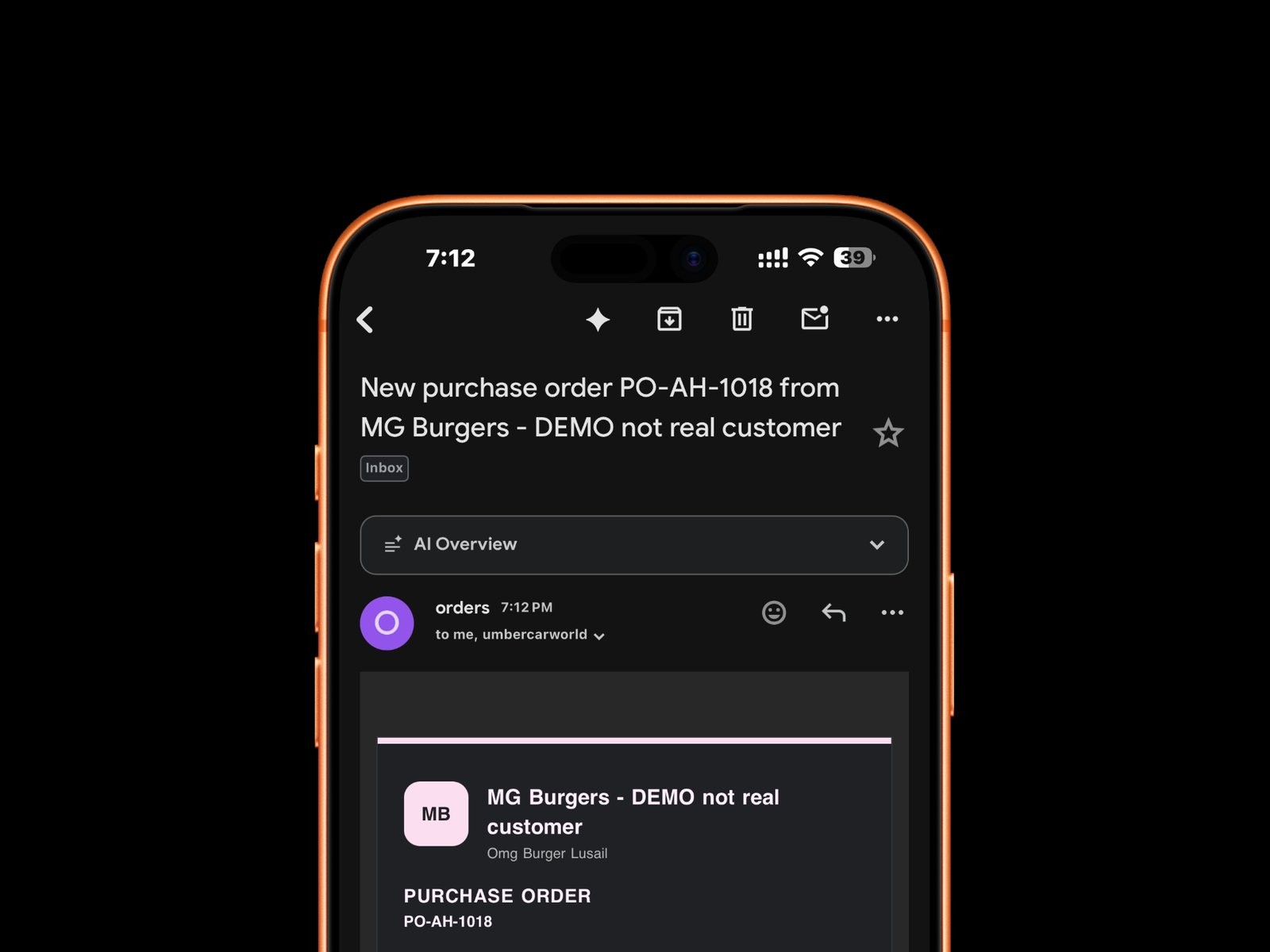
Your customer orders at their price. They see only their own price and their own minimum order.
The order arrives structured, in one place. The purchase order (LPO) is generated automatically the moment they send it.
You adjust before you accept. Change the quantity or the price, or swap the product. The customer sees the confirmed order right away.
You chat beside the order. Message the customer from inside the system.
A customer with several branches has one account, and you can set a special delivery term for a specific customer, like Friday delivery. See orders. Qatar's Ministry of Public Health published a Food Safety Practices Guide for Food Services that includes traceability and recall requirements. See the pricing page for the plans.
Wady is not a marketplace. It is your own ordering system for your own customers. Nobody sees your catalogue without your code, and prices are per customer.
Looking at it from the buying side? Read about restaurant purchasing software.
Talk to us about your orders
Talk to the Wady team, and we will show you how every order lands in one place, and how you decide on it before accepting.
Frequently asked questions
Your customers' orders, prices and data, in one system.


